117333
论文已发表
注册即可获取德孚的最新动态
IF 收录期刊
- 3.6 Breast Cancer (Dove Med Press)
- 4.3 Clin Epidemiol
- 2.6 Cancer Manag Res
- 3.2 Infect Drug Resist
- 4.1 Clin Interv Aging
- 6.1 Drug Des Dev Ther
- 4.1 Int J Chronic Obstr
- 8.7 Int J Nanomed
- 2.5 Int J Women's Health
- 3.2 Neuropsych Dis Treat
- 2.4 OncoTargets Ther
- 2.6 Patient Prefer Adher
- 2.6 Ther Clin Risk Manag
- 3.1 J Pain Res
- 3.5 Diabet Metab Synd Ob
- 4.5 Psychol Res Behav Ma
- 3.4 Nat Sci Sleep
- 2.4 Pharmgenomics Pers Med
- 2.6 Risk Manag Healthc Policy
- 4.6 J Inflamm Res
- 2.3 Int J Gen Med
- 3.9 J Hepatocell Carcinoma
- 3.3 J Asthma Allergy
- 2.5 Clin Cosmet Investig Dermatol
- 3.0 J Multidiscip Healthc

在线购物中的低阶网页布局促进购买决策:来自事件相关电位的证据
Authors Shang Q, Jin J, Pei G, Wang C, Wang X, Qiu J
Received 14 November 2019
Accepted for publication 25 December 2019
Published 10 January 2020 Volume 2020:13 Pages 29—39
DOI https://doi.org/10.2147/PRBM.S238581
Checked for plagiarism Yes
Review by Single-blind
Peer reviewer comments 2
Editor who approved publication: Professor Mei-chun Cheung
Introduction: In online shopping, the webpage layout plays an important part in the consumer’s experience. The present study aims to investigate whether the webpage order and which order level (high order vs low order) facilitate consumers’ instant purchase decisions for products.
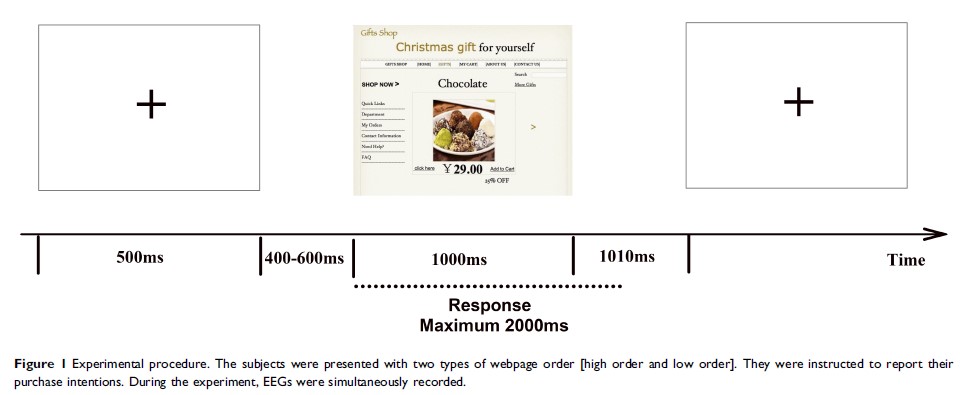
Methods: Fourteen right-handed healthy undergraduates and graduate students participated in the experiment as paid participants. In the experiment, participants were presented with daily products in different online shopping webpages (high-order vs low-order) and reported their purchase intentions between purchase and not purchase. Meanwhile, Electroencephalogram (EEG) was recorded from the participants throughout the experiment. In the analysis process, two event-related potentials (ERP) components, P2 and late positive potential (LPP) were mainly focused to examine the cognitive mechanism underlying the purchase decisions.
Results: The behavioral data found that the low-order shopping webpage facilitated participants’ purchase intentions compared with the high-order one. Neurophysiologically, increased P2 amplitudes and increased LPP amplitudes were revealed for the low-order webpage compared to the high-order webpage. The P2 indicates the early stage of attention engagement and discordant perception, while the LPP can be taken as a reflection of the late stage of the emotional self-control process.
Conclusion: These results provided evidence that webpage order influenced people’s purchase decisions. Low-order webpage design invoked more attention engagement and discordant perception and consumed more self-control resources than the high-order webpage design, which contributed to the higher purchase intentions.
Keywords: online shopping, webpage order, purchase decisions, event-related potentials, P2, LPP