117333
论文已发表
注册即可获取德孚的最新动态
IF 收录期刊
- 3.6 Breast Cancer (Dove Med Press)
- 4.3 Clin Epidemiol
- 2.6 Cancer Manag Res
- 3.2 Infect Drug Resist
- 4.1 Clin Interv Aging
- 6.1 Drug Des Dev Ther
- 4.1 Int J Chronic Obstr
- 8.7 Int J Nanomed
- 2.5 Int J Women's Health
- 3.2 Neuropsych Dis Treat
- 2.4 OncoTargets Ther
- 2.6 Patient Prefer Adher
- 2.6 Ther Clin Risk Manag
- 3.1 J Pain Res
- 3.5 Diabet Metab Synd Ob
- 4.5 Psychol Res Behav Ma
- 3.4 Nat Sci Sleep
- 2.4 Pharmgenomics Pers Med
- 2.6 Risk Manag Healthc Policy
- 4.6 J Inflamm Res
- 2.3 Int J Gen Med
- 3.9 J Hepatocell Carcinoma
- 3.3 J Asthma Allergy
- 2.5 Clin Cosmet Investig Dermatol
- 3.0 J Multidiscip Healthc

miR106a 促进了移植乳腺癌的生长,并降低了移植瘤对顺铂的敏感性
Authors You F, Li J, Zhang P, Zhang H, Cao X
Received 17 September 2019
Accepted for publication 7 December 2019
Published 13 January 2020 Volume 2020:12 Pages 233—246
DOI https://doi.org/10.2147/CMAR.S231375
Checked for plagiarism Yes
Review by Single-blind
Peer reviewer comments 2
Editor who approved publication: Dr Eileen O'Reilly
Objective: To explore the effect of miR106a on the growth of breast cancer xenografts and the sensitivity of chemotherapeutic agents.
Methods: Breast cancer cell lines (MDA-MB231 and MCF7) were transfected with an miR106 mimic and miR106a inhibitor. BALB/c female nude mice were selected to construct a transplanted-tumor model. Cisplatin treatment was performed 2 weeks after inoculation. After 5 weeks, tumor tissue was weighed. Apoptosis of tumor cells was detected by TUNEL staining. The expression of these proteins (Ki67, β-catenin, cyclin D1 and cMyc) was detected by immunohistochemistry. The contents of P53 , RUNX3 , ABCG2 , β-catenin, BAX , and BCL2 mRNA were detected by qRT-PCR.
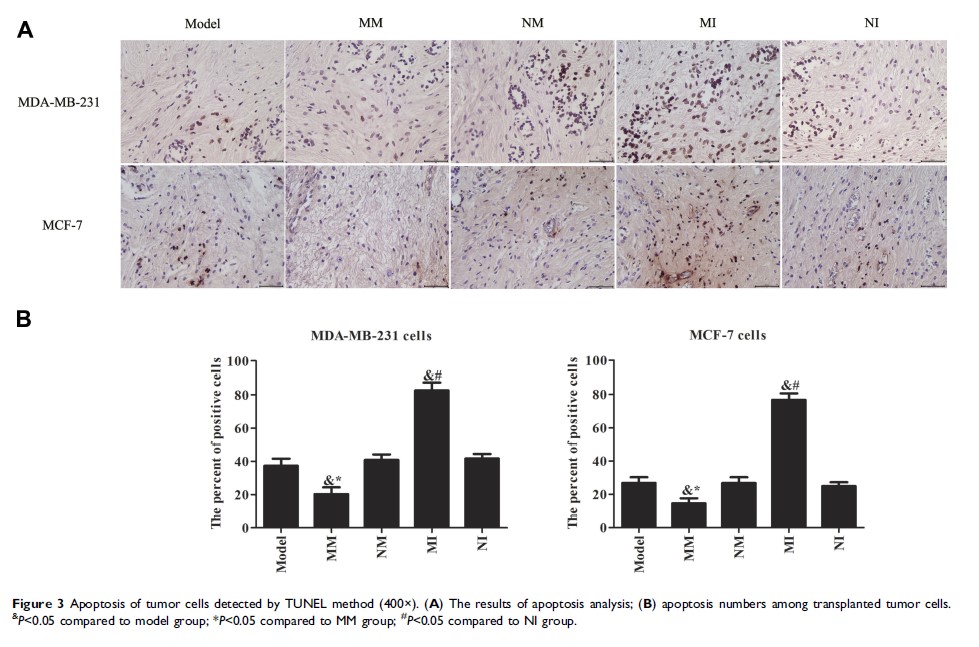
Results: The miR106a mimic (MM) group’s tumor volume and weight were significantly bigger than those of the model group. miR106a mRNA content was higher than the blank control group, and β-catenin and Ki67 protein were strongly positive. β-catenin, BCL2 , and ABCG2 mRNA content was were increased. P53 , BAX , and RUNX3 mRNA content was decreased. The number of positive cells on TUNEL staining was significantly lower in the miR106a inhibitor (MI) group. After cisplatin treatment, inhibition of tumor growth was most obvious in the MI+DDP (cisplatin) group. Compared with the MM group, tumor growth in the MM+FH535 (Wnt-pathway inhibitor) group was significantly lower, and Wnt-pathway activity was decreased.
Conclusion: Overexpression of miR106a can promote the growth of transplanted breast cancer and decrease the sensitivity of transplanted tumors to cisplatin. The mechanism may be related to abnormal activation of the Wnt-signaling pathway.
Keywords: miR106a, breast cancer transplantation tumor, MDA-MB231, MCF7, chemotherapeutic drug sensitivity