117518
论文已发表
注册即可获取德孚的最新动态
IF 收录期刊
- 3.6 Breast Cancer (Dove Med Press)
- 4.3 Clin Epidemiol
- 2.6 Cancer Manag Res
- 3.2 Infect Drug Resist
- 4.1 Clin Interv Aging
- 6.1 Drug Des Dev Ther
- 4.1 Int J Chronic Obstr
- 8.7 Int J Nanomed
- 2.5 Int J Women's Health
- 3.2 Neuropsych Dis Treat
- 2.4 OncoTargets Ther
- 2.6 Patient Prefer Adher
- 2.6 Ther Clin Risk Manag
- 3.1 J Pain Res
- 3.5 Diabet Metab Synd Ob
- 4.5 Psychol Res Behav Ma
- 3.4 Nat Sci Sleep
- 2.4 Pharmgenomics Pers Med
- 2.6 Risk Manag Healthc Policy
- 4.6 J Inflamm Res
- 2.3 Int J Gen Med
- 3.9 J Hepatocell Carcinoma
- 3.3 J Asthma Allergy
- 2.5 Clin Cosmet Investig Dermatol
- 3.0 J Multidiscip Healthc

血清铁蛋白可独立预测 2 型糖尿病患者的慢性肾脏病发病率
Authors Wu YH, Wang SY, Li MX, He H, Yin WJ, Guo YH, Zhang HQ, Sun ZM, Zhang D, Wang X, Sun SY, Tang SX, Du R, Zhang CH
Received 22 August 2019
Accepted for publication 29 November 2019
Published 14 January 2020 Volume 2020:13 Pages 99—105
DOI https://doi.org/10.2147/DMSO.S228335
Checked for plagiarism Yes
Review by Single-blind
Peer reviewer comments 2
Editor who approved publication: Prof. Dr. Juei-Tang Cheng
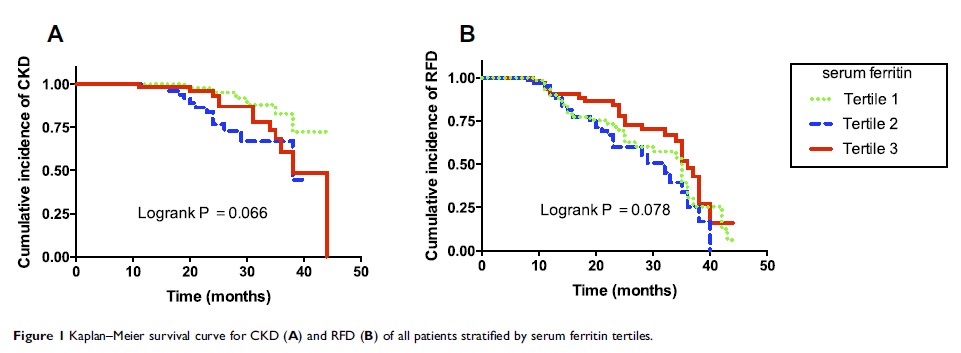
Aim: This study aimed to determine whether serum ferritin (SF) is an independent risk factor of the incidence of chronic kidney disease (CKD) and rapid renal function decline (RFD) in male Tibetan patients with type 2 diabetes mellitus (T2DM).
Methods: We performed a retrospective cohort study that included 191 male Tibetan patients with T2DM without CKD. Patients were divided into three groups according to the level of SF. The following outcomes were measured: cumulative incidence of chronic kidney disease [i.e. estimated glomerular filtration rate (eGFR) < 60 mL/min per 1.73 m 2 and/or urinary albumin/creatine ratio (ACR) ≥ 30 mg/g] and RFD (i.e. decrease in eGFR of ≥ 25% from baseline or a decline rate of ≥ 3 mL/min per 1.73 m 2 annually).
Results: In total, over a median follow-up period of 23 months, 30 (15.7%) and 89 patients (46.6%) developed CKD and RFD. In multivariable Cox models, a 100 ng/mL increment in SF was associated with a 1.12-fold (95% CI: 1.02– 1.24) higher adjusted risk for incidence of CKD. The adjusted-HR of CKD was 1.31 (95% CI: 0.38– 4.53) and 2.92 (95% CI: 0.87– 9.77) for those in tertile 2 and tertile 3, respectively, compared with the patients in tertile 1. However, SF was not significantly associated with RFD (adjusted-HR: 1.06, 95% CI: 0.99– 1.14).
Conclusion: Serum ferritin independently predicts the incidence of CKD in male Tibetan patients with T2DM. High levels of serum ferritin may play a role in the pathogenesis leading to the development of CKD in T2DM.
Keywords: serum ferritin, chronic kidney disease, type 2 diabetes mellitus