117518
论文已发表
注册即可获取德孚的最新动态
IF 收录期刊
- 3.6 Breast Cancer (Dove Med Press)
- 4.3 Clin Epidemiol
- 2.6 Cancer Manag Res
- 3.2 Infect Drug Resist
- 4.1 Clin Interv Aging
- 6.1 Drug Des Dev Ther
- 4.1 Int J Chronic Obstr
- 8.7 Int J Nanomed
- 2.5 Int J Women's Health
- 3.2 Neuropsych Dis Treat
- 2.4 OncoTargets Ther
- 2.6 Patient Prefer Adher
- 2.6 Ther Clin Risk Manag
- 3.1 J Pain Res
- 3.5 Diabet Metab Synd Ob
- 4.5 Psychol Res Behav Ma
- 3.4 Nat Sci Sleep
- 2.4 Pharmgenomics Pers Med
- 2.6 Risk Manag Healthc Policy
- 4.6 J Inflamm Res
- 2.3 Int J Gen Med
- 3.9 J Hepatocell Carcinoma
- 3.3 J Asthma Allergy
- 2.5 Clin Cosmet Investig Dermatol
- 3.0 J Multidiscip Healthc

环指蛋白 38 可介导 LIM 域结合蛋白 1 降解并调节结直肠癌中的细胞生长
Authors Huang Z, Yang P, Ge H, Yang C, Cai Y, Chen Z, Tian W, Wang H
Received 16 October 2019
Accepted for publication 26 December 2019
Published 14 January 2020 Volume 2020:13 Pages 371—379
DOI https://doi.org/10.2147/OTT.S234828
Checked for plagiarism Yes
Review by Single-blind
Peer reviewer comments 2
Editor who approved publication: Dr Sanjay Singh
Background and Objectives: RING finger protein 38 (RNF38) has been reported to be involved in the tumorigenesis of several tumors, but its role in colorectal cancer (CRC) is still not investigated. In the present study, we aimed to investigate the effect of RNF38 in CRC cells.
Materials and Methods: The public tumor databases GEPIA and Kaplan-Meier Plotter were used to analyze RNF38 expression and patients’ overall survival in CRC. The qRT-PCR was carried out to assess the mRNA levels of RNF38 and LDB1. Western blot and co-immunoprecipitation were used to detect protein expression and ubiquitination. CCK-8 assay was performed to analyze CRC cell growth and viability.
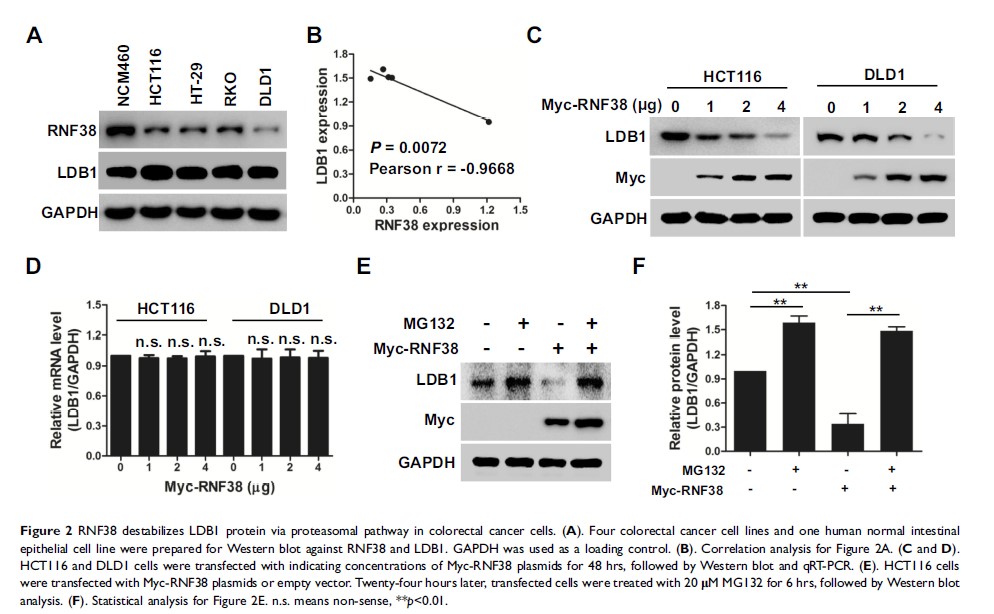
Results: RNF38 was found downregulated in CRC tumor tissues and cell lines, and CRC patients with high RNF38 expression had a longer overall survival than patients with low RNF38 expression. Our further investigations showed that RNF38 interacted with LDB1, and downregulated LDB1 expression by inducing its polyubiquitination. Moreover, overexpression of RNF38 inhibited CRC cell growth but enforced LDB1 could significantly antagonize RNF38-induced cell growth inhibition in CRC cells. Additionally, RNF38/LDB1 axis was involved in the drug sensitivity of 5-FU to CRC cells.
Conclusion: Our studies suggested that RNF38 was functional in CRC cells, and downregulated CRC cell growth by inducing LDB1 polyubiquitination, which indicated that RNF38 could be as a novel target for CRC therapy.
Keywords: RNF38, LDB1, ubiquitination, degradation, colorectal cancer