117518
论文已发表
注册即可获取德孚的最新动态
IF 收录期刊
- 3.6 Breast Cancer (Dove Med Press)
- 4.3 Clin Epidemiol
- 2.6 Cancer Manag Res
- 3.2 Infect Drug Resist
- 4.1 Clin Interv Aging
- 6.1 Drug Des Dev Ther
- 4.1 Int J Chronic Obstr
- 8.7 Int J Nanomed
- 2.5 Int J Women's Health
- 3.2 Neuropsych Dis Treat
- 2.4 OncoTargets Ther
- 2.6 Patient Prefer Adher
- 2.6 Ther Clin Risk Manag
- 3.1 J Pain Res
- 3.5 Diabet Metab Synd Ob
- 4.5 Psychol Res Behav Ma
- 3.4 Nat Sci Sleep
- 2.4 Pharmgenomics Pers Med
- 2.6 Risk Manag Healthc Policy
- 4.6 J Inflamm Res
- 2.3 Int J Gen Med
- 3.9 J Hepatocell Carcinoma
- 3.3 J Asthma Allergy
- 2.5 Clin Cosmet Investig Dermatol
- 3.0 J Multidiscip Healthc

氧化应激导致骨质疏松小鼠痛觉过敏
Authors Tu C, Wu DZ, Huang YS, Zhuang JS, Zeng JH, Xu P, Meng TT, Zhong ZM
Received 11 October 2019
Accepted for publication 24 December 2019
Published 15 January 2020 Volume 2020:13 Pages 131—142
DOI https://doi.org/10.2147/JPR.S234334
Checked for plagiarism Yes
Review by Single-blind
Peer reviewer comments 2
Editor who approved publication: Dr Michael A Überall
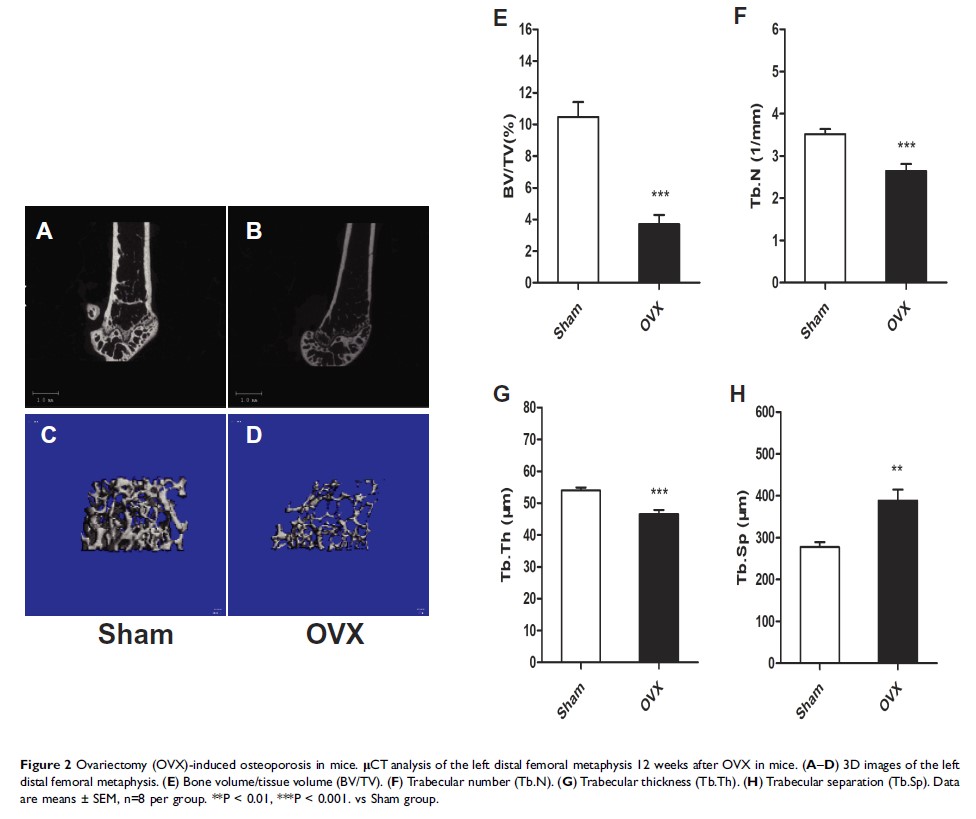
Purpose: Chronic pain is one of the most common complications of postmenopausal osteoporosis. Since oxidative stress is involved in the pathogenesis of postmenopausal osteoporosis, we explored whether oxidative stress contributes to postmenopausal osteoporotic pain.
Methods: Osteoporosis was induced in mice by ovariectomy (OVX). Pain-related behaviours were assessed by measuring sensitivity to mechanical, thermal and cold stimulation. The expression of pain-related transcripts, such acid-sensing ion channel 3 (ASIC3), transient receptor potential vanilloid 1 (TRPV1) and calcitonin gene-related peptide (CGRP), was evaluated. Plasma markers of oxidative stress were also measured. In addition, the effects of the reactive oxygen species scavenger phenyl N-tert-butylnitrone (PBN) on these parameters were assessed.
Results: The OVX mice presented hyperalgesia, as demonstrated by decreased paw withdrawal thresholds to mechanical stimulation and withdrawal latencies to thermal and cold stimulation, along with upregulated expression of ASIC3, TRPV1 and CGRP in the dorsal root ganglia, spinal cord and thalamus tissue. OVX elevated the plasma levels of malondialdehyde (MDA) and advanced oxidation protein products (AOPPs). However, the administration of PBN alleviated these effects.
Conclusion: Our results indicated that oxidative stress contributes to hyperalgesia in OVX mice. Enhanced oxidative stress may be associated with osteoporotic pain. Antioxidant treatment could help alleviate chronic pain in postmenopausal osteoporotic patients.
Keywords: osteoporosis, hyperalgesia, oxidative stress, PBN