117518
论文已发表
注册即可获取德孚的最新动态
IF 收录期刊
- 3.6 Breast Cancer (Dove Med Press)
- 4.3 Clin Epidemiol
- 2.6 Cancer Manag Res
- 3.2 Infect Drug Resist
- 4.1 Clin Interv Aging
- 6.1 Drug Des Dev Ther
- 4.1 Int J Chronic Obstr
- 8.7 Int J Nanomed
- 2.5 Int J Women's Health
- 3.2 Neuropsych Dis Treat
- 2.4 OncoTargets Ther
- 2.6 Patient Prefer Adher
- 2.6 Ther Clin Risk Manag
- 3.1 J Pain Res
- 3.5 Diabet Metab Synd Ob
- 4.5 Psychol Res Behav Ma
- 3.4 Nat Sci Sleep
- 2.4 Pharmgenomics Pers Med
- 2.6 Risk Manag Healthc Policy
- 4.6 J Inflamm Res
- 2.3 Int J Gen Med
- 3.9 J Hepatocell Carcinoma
- 3.3 J Asthma Allergy
- 2.5 Clin Cosmet Investig Dermatol
- 3.0 J Multidiscip Healthc

透视引导下经皮骶椎成形术治疗骶骨翼骨转移疼痛
Authors Tian QH, Liu HF, Wang T, Wu CG, Cheng YS
Received 8 November 2018
Accepted for publication 9 July 2019
Published 16 January 2020 Volume 2020:13 Pages 151—156
DOI https://doi.org/10.2147/JPR.S193866
Checked for plagiarism Yes
Review by Single-blind
Peer reviewer comments 2
Editor who approved publication: Dr Katherine Hanlon
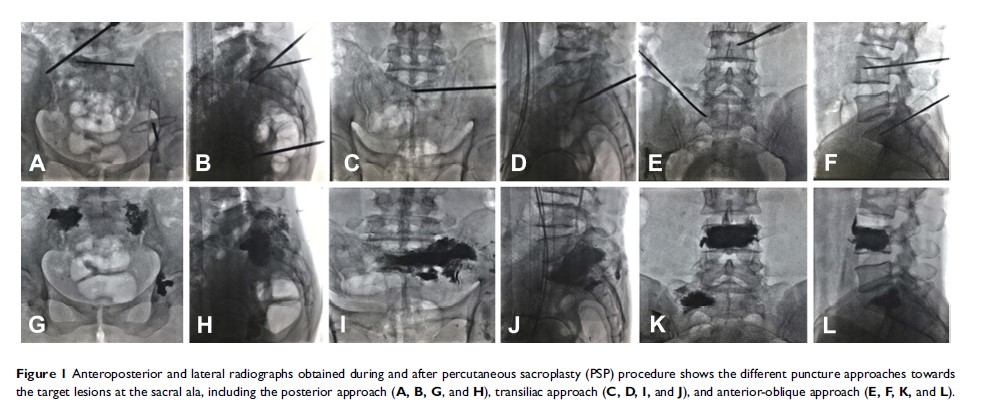
Objective: Percutaneous sacroplasty (PSP) is widely used in the clinic for osteoporotic sacral insufficiency fractures; however, few reports have described the safety and effectiveness of PSP for painful sacral metastases at the sacral ala under fluoroscopy alone. We aimed to evaluate the safety and efficacy of fluoroscopy-guided PSP for painful metastases at the sacral ala.
Patients and Methods: Thirty-five consecutive patients (median age, 60.74 ± 12.74 years), with a total of 41 metastatic lesions at the sacral ala, were treated with PSP. The patients were followed up for periods ranging from 1 month to 30 months (average, 8.23 ± 6.75 months). The visual analog scale (VAS), Oswestry Disability Index (ODI), and Karnofsky Performance Scale (KPS) were used to evaluate pain, mobility, and quality of life before the procedure and at 3 days and 1, 3, 6, 12, and 18 months after the procedure.
Results: Technical success was achieved in all patients. The minimum follow-up duration was 1 month. The mean VAS scores declined significantly from 7.20 ± 0.93 before the procedure to 3.43 ± 1.38 by day 3 after the procedure, and was 3.13 ± 1.07 at 1 month, 3.17 ± 1.15 at 3 months, 2.91± 1.38 at 6 months, and 2.57 ± 1.51 at 12 months after the procedure (P < 0.001). After PSP, analgesic drug administration had been discontinued in 31 of 35 patients (88.57%). The ODI and KPS also changed after PSP, with significant differences between the baseline scores and those at each follow-up examination (P < 0.001). Extraosseous cement leakage occurred in 12 cases without any major clinical complications.
Conclusion: PSP is a safe and effective technique for the palliative treatment of painful metastases involving the sacral ala under fluoroscopic guidance alone. It can relieve pain, reduce disability, and improve function, and is associated with minimal complications.
Keywords: percutaneous sacroplasty, metastases, sacral ala