117518
论文已发表
注册即可获取德孚的最新动态
IF 收录期刊
- 3.6 Breast Cancer (Dove Med Press)
- 4.3 Clin Epidemiol
- 2.6 Cancer Manag Res
- 3.2 Infect Drug Resist
- 4.1 Clin Interv Aging
- 6.1 Drug Des Dev Ther
- 4.1 Int J Chronic Obstr
- 8.7 Int J Nanomed
- 2.5 Int J Women's Health
- 3.2 Neuropsych Dis Treat
- 2.4 OncoTargets Ther
- 2.6 Patient Prefer Adher
- 2.6 Ther Clin Risk Manag
- 3.1 J Pain Res
- 3.5 Diabet Metab Synd Ob
- 4.5 Psychol Res Behav Ma
- 3.4 Nat Sci Sleep
- 2.4 Pharmgenomics Pers Med
- 2.6 Risk Manag Healthc Policy
- 4.6 J Inflamm Res
- 2.3 Int J Gen Med
- 3.9 J Hepatocell Carcinoma
- 3.3 J Asthma Allergy
- 2.5 Clin Cosmet Investig Dermatol
- 3.0 J Multidiscip Healthc

中国普通人群中全身性炎症介导的腹部肥胖指数与肺功能下降之间的关联
Authors He H, Wang B, Zhou M, Cao L, Qiu W, Mu G, Chen A, Yang S, Chen W
Received 3 September 2019
Accepted for publication 29 November 2019
Published 20 January 2020 Volume 2020:13 Pages 141—150
DOI https://doi.org/10.2147/DMSO.S229749
Checked for plagiarism Yes
Review by Single-blind
Peer reviewer comments 3
Editor who approved publication: Prof. Dr. Juei-Tang Cheng
Background: Previous studies reported that obesity indices were inversely associated with lung function. However, the underlying mechanisms remain unclear. We aimed to assess the potential mediating effect of systemic inflammation in the associations between obesity indices and lung function decline among a general population.
Methods: We conducted a cross-sectional study among 3442 participants from the Wuhan-Zhuhai cohort. Plasma C-reactive protein (CRP) was assayed as a marker of systemic inflammation. The relationships among several obesity indices (body mass index, BMI; waist circumference, WC; waist-to-hip ratio, WHR; waist-to-height ratio, WHtR), plasma CRP and lung function were assessed by generalized linear models. The role of CRP in the associations between obesity indices and lung function was analyzed using mediation analysis.
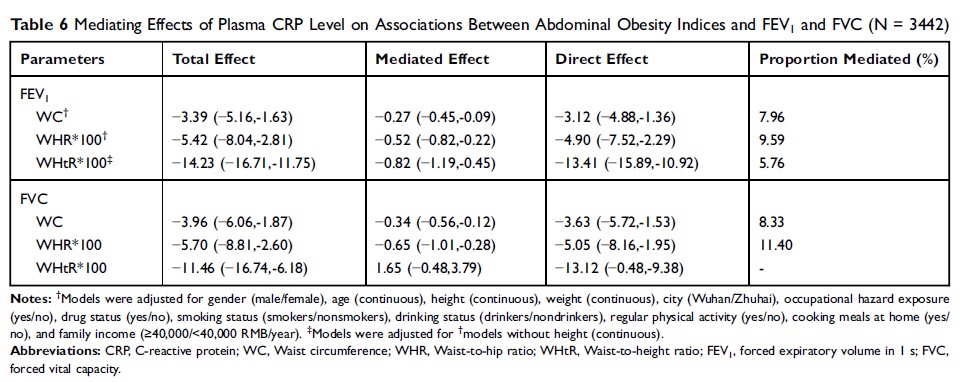
Results: We observed inverse associations between abdominal obesity indices (WC, WHR and WHtR) and lung function parameters, including forced expiratory volume in 1 s (FEV 1) and forced vital capacity (FVC) (all P < 0.05). Each 1-unit increase in WC was associated with a 3.39 mL decrease in FEV 1 and a 3.96 mL decrease in FVC (all P < 0.05). Each 1% increase in WHR and WHtR was associated with a 5.42 mL and a 14.23 mL decrease in FEV 1, and a 5.70 mL and a 16.92 mL decrease in FVC (all P < 0.05). Mediation analysis indicated that plasma CRP partly mediated the associations between abdominal obesity and lung function. The mediated proportions of CRP in associations of WC, WHR and WHtR with FEV 1 were 7.96%, 9.59% and 5.76%, respectively. The mediated proportions of CRP in associations of WC and WHR with FVC were 8.33% and 11.40%, respectively.
Conclusion: Abdominal obesity indices were negatively associated with lung function, and the associations may be partly mediated by systemic inflammation.
Keywords: abdominal obesity, systemic inflammation, lung function, mediation analysis