117518
论文已发表
注册即可获取德孚的最新动态
IF 收录期刊
- 3.6 Breast Cancer (Dove Med Press)
- 4.3 Clin Epidemiol
- 2.6 Cancer Manag Res
- 3.2 Infect Drug Resist
- 4.1 Clin Interv Aging
- 6.1 Drug Des Dev Ther
- 4.1 Int J Chronic Obstr
- 8.7 Int J Nanomed
- 2.5 Int J Women's Health
- 3.2 Neuropsych Dis Treat
- 2.4 OncoTargets Ther
- 2.6 Patient Prefer Adher
- 2.6 Ther Clin Risk Manag
- 3.1 J Pain Res
- 3.5 Diabet Metab Synd Ob
- 4.5 Psychol Res Behav Ma
- 3.4 Nat Sci Sleep
- 2.4 Pharmgenomics Pers Med
- 2.6 Risk Manag Healthc Policy
- 4.6 J Inflamm Res
- 2.3 Int J Gen Med
- 3.9 J Hepatocell Carcinoma
- 3.3 J Asthma Allergy
- 2.5 Clin Cosmet Investig Dermatol
- 3.0 J Multidiscip Healthc

脑脊液中簇集蛋白水平与整个阿尔茨海默氏病连续体中突触的变性之间的关联
Authors Wang J, Zhang X, Zhu B, Fu P
Received 26 July 2019
Accepted for publication 20 December 2019
Published 20 January 2020 Volume 2020:16 Pages 183—190
DOI https://doi.org/10.2147/NDT.S224877
Checked for plagiarism Yes
Review by Single-blind
Peer reviewer comments 3
Editor who approved publication: Professor Jun Chen
Purpose: Although emerging evidence has suggested that clusterin is involved in the pathogenesis of Alzheimer’s disease (AD), the association of clusterin with synaptic degeneration in living human is unclear. In the present study, we aimed to examine the association of CSF clusterin levels with synaptic degeneration in individuals with different severities of cognitive impairment.
Patients and Methods: In the present study, we compared levels of clusterin in CSF among individuals with normal cognition (NC), mild cognitive impairment (MCI), and AD. Further, linear regression models were performed to examine the association of CSF clusterin with neurogranin (NG, reflecting synaptic degeneration) with adjustment of several potential confounders.
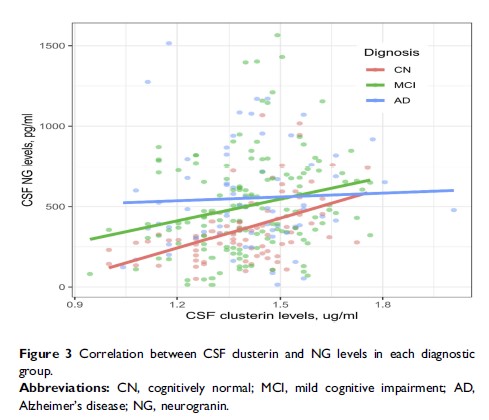
Results: We found that CSF clusterin levels were positively correlated with NG in the NC and MCI groups, but not the AD group. In all subjects, linear regression models suggested that clusterin levels were positively associated with NG levels independent of age, gender, apolipoprotein E4 (APOE4) genotype, clinical diagnosis, and CSF Aβ 42 levels.
Conclusion: Our data indicated that clusterin was associated with CSF NG levels among older individuals with different severities of cognitive impairment.
Keywords: clusterin, neurogranin, synaptic degeneration, Alzheimer’s disease, mild cognitive impairment