117518
论文已发表
注册即可获取德孚的最新动态
IF 收录期刊
- 3.6 Breast Cancer (Dove Med Press)
- 4.3 Clin Epidemiol
- 2.6 Cancer Manag Res
- 3.2 Infect Drug Resist
- 4.1 Clin Interv Aging
- 6.1 Drug Des Dev Ther
- 4.1 Int J Chronic Obstr
- 8.7 Int J Nanomed
- 2.5 Int J Women's Health
- 3.2 Neuropsych Dis Treat
- 2.4 OncoTargets Ther
- 2.6 Patient Prefer Adher
- 2.6 Ther Clin Risk Manag
- 3.1 J Pain Res
- 3.5 Diabet Metab Synd Ob
- 4.5 Psychol Res Behav Ma
- 3.4 Nat Sci Sleep
- 2.4 Pharmgenomics Pers Med
- 2.6 Risk Manag Healthc Policy
- 4.6 J Inflamm Res
- 2.3 Int J Gen Med
- 3.9 J Hepatocell Carcinoma
- 3.3 J Asthma Allergy
- 2.5 Clin Cosmet Investig Dermatol
- 3.0 J Multidiscip Healthc

卒中后抑郁症与估计的肾小球滤过率:一项回顾性中风队列研究
Authors Lin S, Luan X, He W, Ruan Y, Yuan C, Fan A, Chen X, He J
Received 3 August 2019
Accepted for publication 12 November 2019
Published 21 January 2020 Volume 2020:16 Pages 201—208
DOI https://doi.org/10.2147/NDT.S225905
Checked for plagiarism Yes
Review by Single-blind
Peer reviewer comments 2
Editor who approved publication: Professor Jun Chen
Purpose: Post-stroke depression (PSD) is a frequent comorbidity in patients presenting with acute ischemic stroke. Impaired kidney function has been associated with depression in non-stroke subjects. We would like to evaluate whether the estimated glomerular filtration rate (eGFR) on admission is associated with the development of PSD.
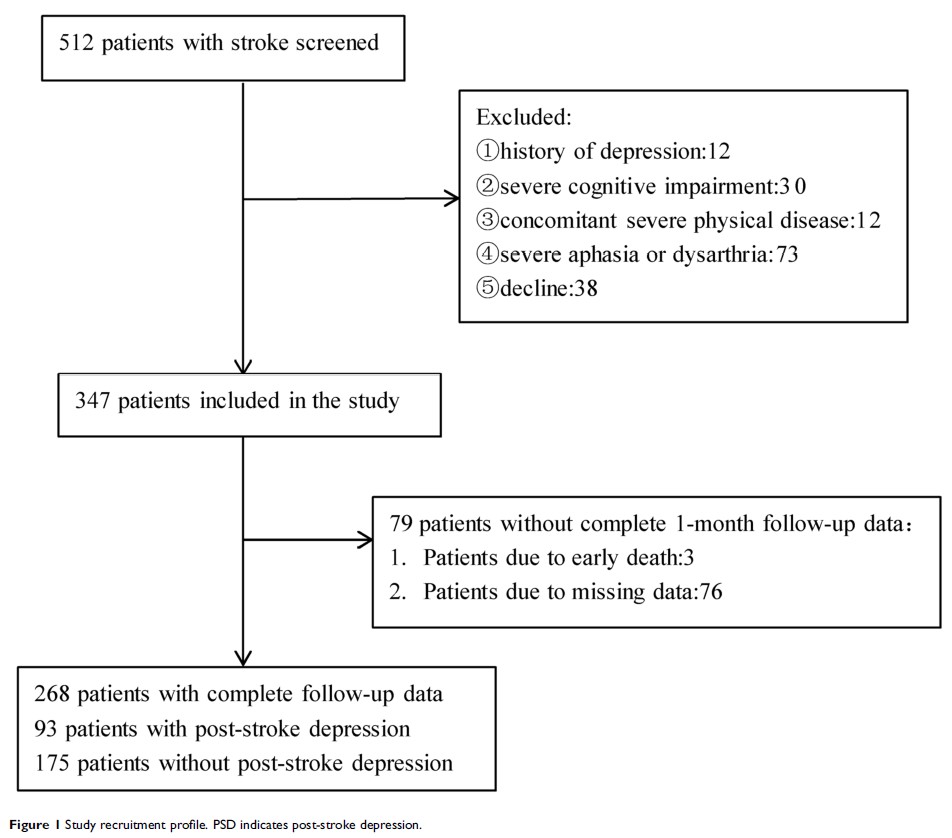
Patients and methods: Total of 268 patients with acute ischemic stroke were recruited and completed 1-month follow-up visit. eGFR was calculated from the serum creatinine value, race, age, and sex by using the chronic kidney disease epidemiology collaboration equation (CKD-EPI creatinine equation). The 17-item Hamilton Depression Scale was used to evaluate depression symptoms. Patients with a depression score of ≥ 7 were evaluated using the Structured Clinical Interview for Diagnostic and Statistical Manual of Mental Disorders, 4th edition, for diagnosing post-stroke depression at 1 month. Meanwhile, 114 normal control subjects were also recruited.
Results: Ninety-three (34.7%) patients were diagnosed as having PSD at 1 month. There was a significant intergroup difference in eGFR levels within 24 hrs after admission (F=13.608, p< 0.001). The levels of eGFR within 24 hrs after admission were significantly lower in both non-PSD patients and PSD patients than in normal controls. In logistic regression, the level of eGFR (< 82mL/min/1.73m 2) was independently associated with increased risk of PSD even after adjusting for confounders (OR=2.328, 95% CI:1.092– 4.965, p=0.029).
Conclusion: Reduced eGFR was found to be correlated with the development of PSD and it suggests the need for greater attentions and potential interventions for depression in patients with stroke and with reduced eGFR.
Keywords: estimated glomerular filtration rate, eGFR, post-stroke depression, stroke, Depression