117518
论文已发表
注册即可获取德孚的最新动态
IF 收录期刊
- 3.6 Breast Cancer (Dove Med Press)
- 4.3 Clin Epidemiol
- 2.6 Cancer Manag Res
- 3.2 Infect Drug Resist
- 4.1 Clin Interv Aging
- 6.1 Drug Des Dev Ther
- 4.1 Int J Chronic Obstr
- 8.7 Int J Nanomed
- 2.5 Int J Women's Health
- 3.2 Neuropsych Dis Treat
- 2.4 OncoTargets Ther
- 2.6 Patient Prefer Adher
- 2.6 Ther Clin Risk Manag
- 3.1 J Pain Res
- 3.5 Diabet Metab Synd Ob
- 4.5 Psychol Res Behav Ma
- 3.4 Nat Sci Sleep
- 2.4 Pharmgenomics Pers Med
- 2.6 Risk Manag Healthc Policy
- 4.6 J Inflamm Res
- 2.3 Int J Gen Med
- 3.9 J Hepatocell Carcinoma
- 3.3 J Asthma Allergy
- 2.5 Clin Cosmet Investig Dermatol
- 3.0 J Multidiscip Healthc

程序性死亡受体-1 和/或程序性死亡配体 1 抑制剂在肺癌脑转移治疗中的应用
Authors Wang S, Hu C, Xie F, Liu Y
Received 23 October 2019
Accepted for publication 24 December 2019
Published 23 January 2020 Volume 2020:13 Pages 667—683
DOI https://doi.org/10.2147/OTT.S235714
Checked for plagiarism Yes
Review by Single-blind
Peer reviewer comments 2
Editor who approved publication: Prof. Dr. Nicola Silvestris
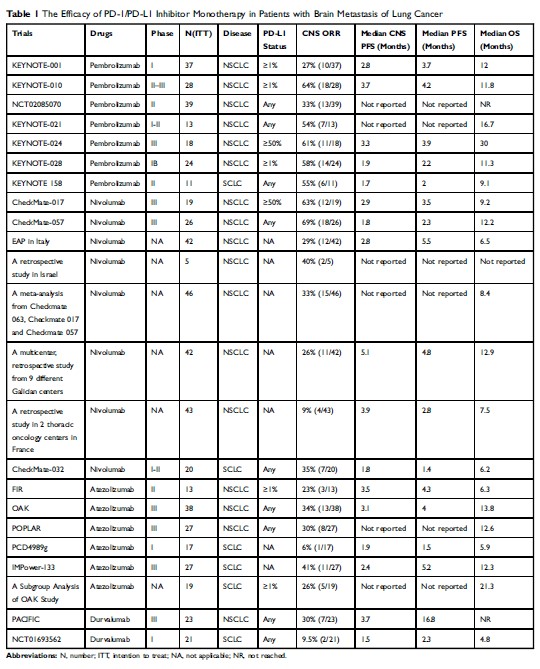
Abstract: The central nervous system (CNS) is regarded as an immune privileged environment; however, changes in the neuroimmunology paradigm have led to an increased interest in systematic immunotherapy in lung cancer therapy. The presence of the lymphatic system in the CNS as well as the physiological and biochemical changes in the blood–brain barrier in the tumor microenvironment suggests that immunocytes are fully capable of entering and exiting the CNS. Emerging clinical data suggest that inhibitors of programmed death receptor-1/programmed death ligand 1 (PD-1/PD-L1) can stimulate surrounding T cells and thus have antitumor effects in the CNS. For example, PD-1 antibody (pembrolizumab) monotherapy has displayed a 20– 30% encephalic response rate in patients with brain metastases from malignant melanoma or non-small cell lung cancer. Combined application of nivolumab and ipilimumab anti-PD-1 and anti-cytotoxic T-lymphocyte-associated protein 4 showed an encephalic response rate of 55% in patients with brain metastases of melanoma. Further evidence is required to verify these response rates and identify the mechanisms of curative effects and drug tolerance. While regional treatments such as whole-brain radiosurgery, stereotactic radiosurgery, and brain surgery remain the mainstream, PD-1/PD-L1 inhibitors display potential decreased neurotoxic effects. To date, five drugs have been approved for use in patients with encephalic metastases of lung carcinoma: the anti-PD-1 drugs, pembrolizumab and nivolumab, and the anti-PD-L1 agents, atezolizumab, durvalumab, and avelumab. In recent years, clinical trials of inhibitors in combination with other drugs to treat brain metastasis have also emerged. This review summarizes the biological principles of PD-1/PD-L1 immunotherapy for brain metastasis of lung cancer, as well as ongoing clinical trials to explore unmet needs.
Keywords: immunotherapy, blood–brain barrier, brain metastasis, lung cancer, PD-1/PD-L1 inhibitors