117518
论文已发表
注册即可获取德孚的最新动态
IF 收录期刊
- 3.6 Breast Cancer (Dove Med Press)
- 4.3 Clin Epidemiol
- 2.6 Cancer Manag Res
- 3.2 Infect Drug Resist
- 4.1 Clin Interv Aging
- 6.1 Drug Des Dev Ther
- 4.1 Int J Chronic Obstr
- 8.7 Int J Nanomed
- 2.5 Int J Women's Health
- 3.2 Neuropsych Dis Treat
- 2.4 OncoTargets Ther
- 2.6 Patient Prefer Adher
- 2.6 Ther Clin Risk Manag
- 3.1 J Pain Res
- 3.5 Diabet Metab Synd Ob
- 4.5 Psychol Res Behav Ma
- 3.4 Nat Sci Sleep
- 2.4 Pharmgenomics Pers Med
- 2.6 Risk Manag Healthc Policy
- 4.6 J Inflamm Res
- 2.3 Int J Gen Med
- 3.9 J Hepatocell Carcinoma
- 3.3 J Asthma Allergy
- 2.5 Clin Cosmet Investig Dermatol
- 3.0 J Multidiscip Healthc

以低分子量 PEI 和上一代 PAMAM 制备的自组装纳米颗粒用于负载 EGFRvIII-嵌合抗原受体基因和 T 细胞瞬时修饰
Authors Yu Q, Zhang M, Chen Y, Chen X, Shi S, Sun K, Ye R, Zheng Y, Chen Y, Xu Y, Peng J
Received 5 September 2019
Accepted for publication 2 January 2020
Published 23 January 2020 Volume 2020:15 Pages 483—495
DOI https://doi.org/10.2147/IJN.S229858
Checked for plagiarism Yes
Review by Single-blind
Peer reviewer comments 2
Editor who approved publication: Dr Mian Wang
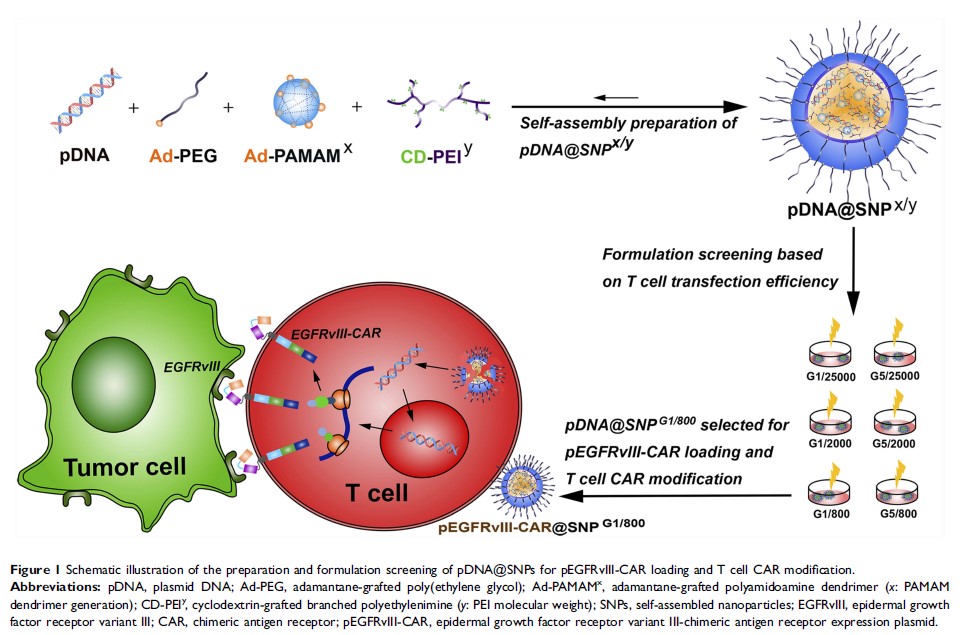
Background: The complex preparation procedures and severe toxicities are two major obstacles facing the wide use of chimeric antigen receptor-modified T (CAR-T) cells in clinical cancer immunotherapy. The nanotechnology-based T cell temporary CAR modification may be a potential approach to solve these problems and make the CAR-T cell-based tumor therapy feasible and broadly applicable.
Methods: A series of plasmid DNA-loaded self-assembled nanoparticles (pDNA@SNPsx/y) prepared from adamantane-grafted polyamidoamine (Ad-PAMAM) dendrimers of different generations (G1 or G5) and cyclodextrin-grafted branched polyethylenimine (CD-PEI) of different molecular weights (800, 2000, or 25,000 Da) were characterized and evaluated. The detailed physicochemical properties, cellular interaction, and cytotoxicity of selected pDNA@SNPG1/800 were systematically investigated. Thereafter, the epidermal growth factor receptor variant III (EGFRvIII) CAR-expression plasmid vector (pEGFRvIII-CAR) was constructed and encapsulated into SNPG1/800. The resulting pEGFRvIII-CAR@SNPG1/800 was used for Jurkat cell transient transfection, and the EGFRvIII-CAR expressed in transfected cells was measured by flow cytometry and Western blot. Finally, the response of EGFRvIII CAR-positive Jurkat T cell to target tumor cell was evaluated.
Results: The pDNA@SNPG1/800 showed the highest efficacy in Jurkat cell gene transfection and exhibited low cytotoxicity. pEGFRvIII-CAR@SNPG1/800 can efficiently deliver pEGFRvIII-CAR into Jurkat T cells, thereby resulting in transient EGFRvIII-CAR expression in transfected cells. EGFRvIII-CAR that is present on the cell membrane enabled Jurkat T cells to recognize and bind specifically with EGFRvIII-positive tumor cells.
Conclusion: These results indicated that pEGFRvIII-CAR@SNPG1/800 can effectively achieve T-cell transient CAR modification, thereby demonstrating considerable potential in CAR-T cancer therapy.
Keywords: self-assembled nanoparticle, PAMAM dendrimer, polyethylenimine, epidermal growth factor receptor variant III, chimeric antigen receptor, T lymphocyte