117806
论文已发表
注册即可获取德孚的最新动态
IF 收录期刊
- 3.6 Breast Cancer (Dove Med Press)
- 4.3 Clin Epidemiol
- 2.6 Cancer Manag Res
- 3.2 Infect Drug Resist
- 4.1 Clin Interv Aging
- 6.1 Drug Des Dev Ther
- 4.1 Int J Chronic Obstr
- 8.7 Int J Nanomed
- 2.5 Int J Women's Health
- 3.2 Neuropsych Dis Treat
- 2.4 OncoTargets Ther
- 2.6 Patient Prefer Adher
- 2.6 Ther Clin Risk Manag
- 3.1 J Pain Res
- 3.5 Diabet Metab Synd Ob
- 4.5 Psychol Res Behav Ma
- 3.4 Nat Sci Sleep
- 2.4 Pharmgenomics Pers Med
- 2.6 Risk Manag Healthc Policy
- 4.6 J Inflamm Res
- 2.3 Int J Gen Med
- 3.9 J Hepatocell Carcinoma
- 3.3 J Asthma Allergy
- 2.5 Clin Cosmet Investig Dermatol
- 3.0 J Multidiscip Healthc

丹皮酚通过抑制 TGF-β1/Smad 信号传导和上皮-间质转化来遏制胰腺癌细胞的迁移和侵袭
Authors Cheng CS, Chen JX, Tang J, Geng YW, Zheng L, Lv LL, Chen LY, Chen Z
Received 24 July 2019
Accepted for publication 3 January 2020
Published 29 January 2020 Volume 2020:12 Pages 641—651
DOI https://doi.org/10.2147/CMAR.S224416
Checked for plagiarism Yes
Review by Single-blind
Peer reviewer comments 2
Editor who approved publication: Dr Beicheng Sun
Purpose: Paeonol, a natural product derived from the root of Cynanchum paniculatum (Bunge) K. Schum and the root of Paeonia suffruticosa Andr. (Ranunculaceae) has attracted extensive attention for its anti-cancer proliferation effect in recent years. The present study examined the role of paeonol in suppressing migration and invasion in pancreatic cancer cells by inhibiting TGF-β 1/Smad signaling.
Methods: Cell viability was evaluated by MTT and colonial formation assay. Migration and invasion capabilities were examined by cell scratch-wound healing assay and the Boyden chamber invasion assay. Western Blot and qRT-PCR were used to measure the protein and RNA levels of vimentin, E-cadherin, N-cadherin, and TGF-β 1/Smad signaling.
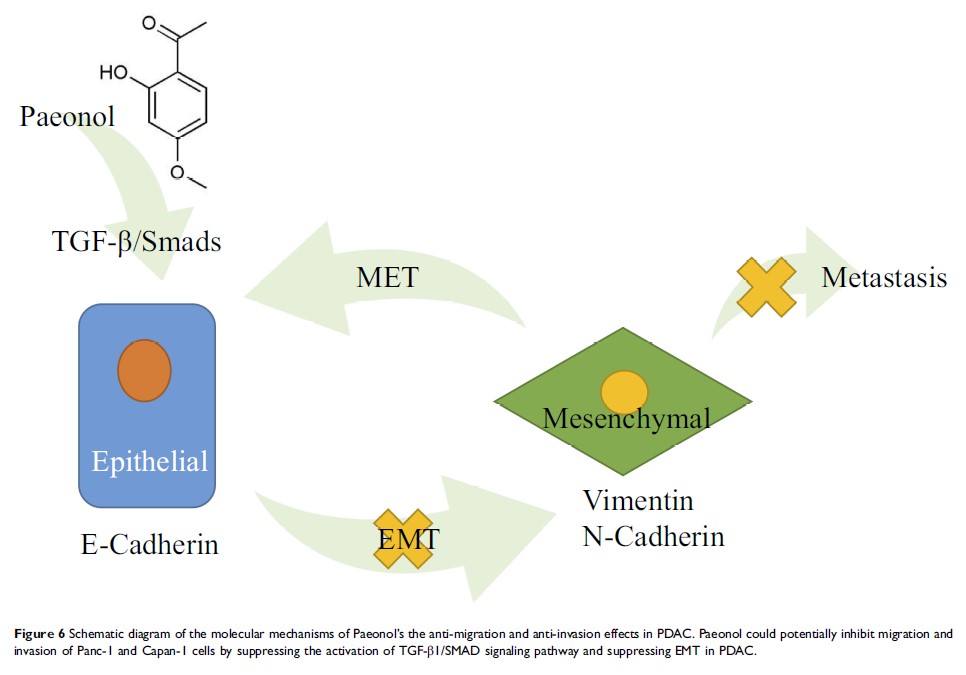
Results: At non-cytotoxic dose, 100 μM and 150 μM of paeonol showed significant anti-migration and anti-invasion effects on Panc-1 and Capan-1 cells (p< 0.01). Paeonol inhibited epithelial-mesenchymal-transition by upregulating E-cadherin, and down regulating N-cadherin and vimentin expressions. Paeonol inhibited TGF-β 1/Smad signaling pathway by downregulating TGF-β 1, p-Smad2/Smad2 and p-Smad3/Smad3 expressions. Further, TGF-β 1 attenuated the anti-migration and anti-invasion capacities of paeonol in Panc-1 and Capan-1 cells.
Conclusion: These findings revealed that paeonol could suppress proliferation and inhibit migration and invasion in Panc-1 and Capan-1 cells by inhibiting the TGF-β 1/Smad pathway and might be a promising novel anti-pancreatic cancer drug.
Keywords: paeonol, pancreatic adenocarcinoma, TGF-β 1/Smad signaling, epithelial-mesenchymal-transition, Cynanchum paniculatum