117806
论文已发表
注册即可获取德孚的最新动态
IF 收录期刊
- 3.6 Breast Cancer (Dove Med Press)
- 4.3 Clin Epidemiol
- 2.6 Cancer Manag Res
- 3.2 Infect Drug Resist
- 4.1 Clin Interv Aging
- 6.1 Drug Des Dev Ther
- 4.1 Int J Chronic Obstr
- 8.7 Int J Nanomed
- 2.5 Int J Women's Health
- 3.2 Neuropsych Dis Treat
- 2.4 OncoTargets Ther
- 2.6 Patient Prefer Adher
- 2.6 Ther Clin Risk Manag
- 3.1 J Pain Res
- 3.5 Diabet Metab Synd Ob
- 4.5 Psychol Res Behav Ma
- 3.4 Nat Sci Sleep
- 2.4 Pharmgenomics Pers Med
- 2.6 Risk Manag Healthc Policy
- 4.6 J Inflamm Res
- 2.3 Int J Gen Med
- 3.9 J Hepatocell Carcinoma
- 3.3 J Asthma Allergy
- 2.5 Clin Cosmet Investig Dermatol
- 3.0 J Multidiscip Healthc

傅立叶变换红外光谱法监测双氢青蒿素诱导下的,卵巢癌细胞和正常的卵巢表面上皮细胞生长的抑制
Authors Li L, Wu J, Weng S, Yang L, Wang H, Xu Y, Shen K
Received 27 November 2019
Accepted for publication 19 January 2020
Published 29 January 2020 Volume 2020:12 Pages 653—661
DOI https://doi.org/10.2147/CMAR.S240285
Checked for plagiarism Yes
Review by Single-blind
Peer reviewer comments 2
Editor who approved publication: Dr Sanjeev Srivastava
Purpose: Ovarian cancer is the most lethal of gynecological malignancies. Dihydroartemisinin (DHA), a derivative of artemisinin (ARS), has profound effects against human tumors. The aim of this study was to provide a convenient, cost-efficient technique, Fourier transform infrared (FTIR) spectroscopy, to monitor and evaluate responses to DHA-induced growth inhibition of ovarian cancer cells.
Methods: Cell growth and viability and the 50% inhibitory concentration (IC50) of DHA were assessed by the MTT assay. FTIR spectroscopy was used to monitor cells following DHA treatment, and data were analyzed by OMNIC 8.0 software.
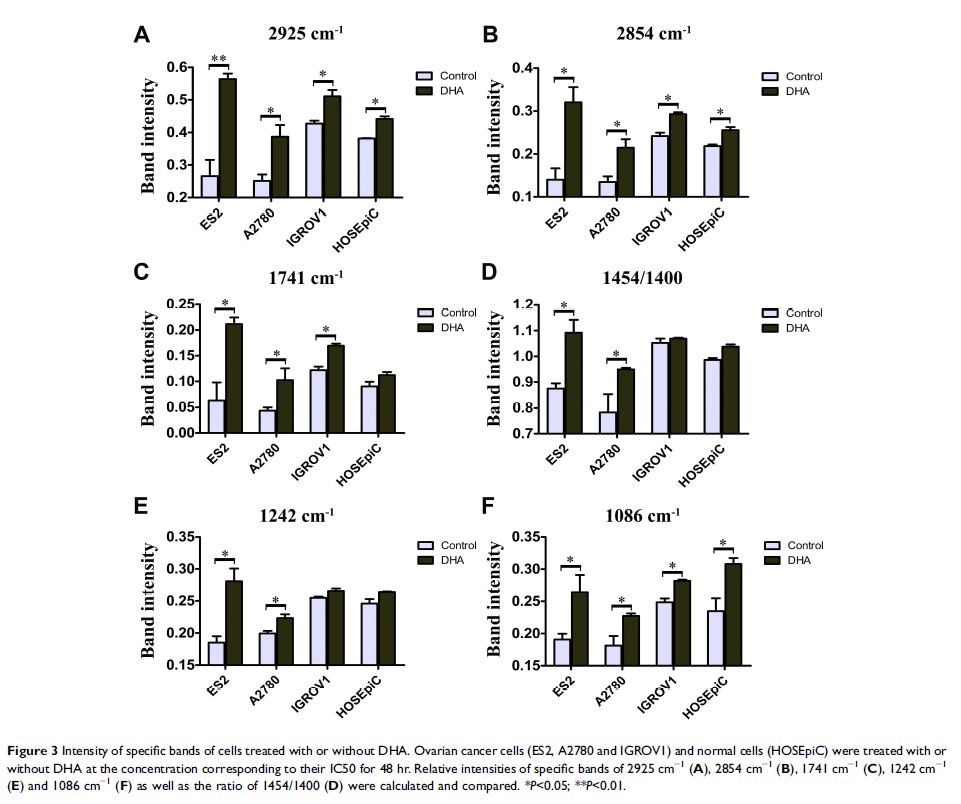
Results: DHA can decrease the viability of ovarian cancer cells and normal cells, but cancer cells were more sensitive to this drug than normal cells. Spectral differences were observed between cells with or without DHA treatment. In particular, an increase in the amount of lipids and nucleic acids was observed. The band intensity ratio of 1454/1400, and the intensity of the band 1741 cm−1 increased, indicating stronger absorption after DHA treatment. Moreover, the differences were larger for the cell lines that were more sensitive to DHA.
Conclusion: The spectral features provided information about important molecular characteristics of the cells in response to chemicals. These findings demonstrated the possible use of FTIR spectroscopy to evaluate DHA-induced growth inhibition effects in ovarian cancer cells and provided a promising new tool for monitoring cell growth and the effects of antitumor drugs in the clinic in the future.
Keywords: ovarian cancer, artemisinin, ARS, dihydroartemisinin, DHA, fourier transform infrared spectroscopy, FTIR spectroscopy, growth inhibition