117806
论文已发表
注册即可获取德孚的最新动态
IF 收录期刊
- 3.6 Breast Cancer (Dove Med Press)
- 4.3 Clin Epidemiol
- 2.6 Cancer Manag Res
- 3.2 Infect Drug Resist
- 4.1 Clin Interv Aging
- 6.1 Drug Des Dev Ther
- 4.1 Int J Chronic Obstr
- 8.7 Int J Nanomed
- 2.5 Int J Women's Health
- 3.2 Neuropsych Dis Treat
- 2.4 OncoTargets Ther
- 2.6 Patient Prefer Adher
- 2.6 Ther Clin Risk Manag
- 3.1 J Pain Res
- 3.5 Diabet Metab Synd Ob
- 4.5 Psychol Res Behav Ma
- 3.4 Nat Sci Sleep
- 2.4 Pharmgenomics Pers Med
- 2.6 Risk Manag Healthc Policy
- 4.6 J Inflamm Res
- 2.3 Int J Gen Med
- 3.9 J Hepatocell Carcinoma
- 3.3 J Asthma Allergy
- 2.5 Clin Cosmet Investig Dermatol
- 3.0 J Multidiscip Healthc

电针治疗通过抑制脊髓胶质细胞和 TLR4/NF-κB 信号通路减轻紫杉醇诱发的大鼠神经性疼痛
Authors Zhao YX, Yao MJ, Liu Q, Xin JJ, Gao JH, Yu XC
Received 4 December 2019
Accepted for publication 14 January 2020
Published 29 January 2020 Volume 2020:13 Pages 239—250
DOI https://doi.org/10.2147/JPR.S241101
Checked for plagiarism Yes
Review by Single-blind
Peer reviewer comments 3
Editor who approved publication: Dr Michael A Überall
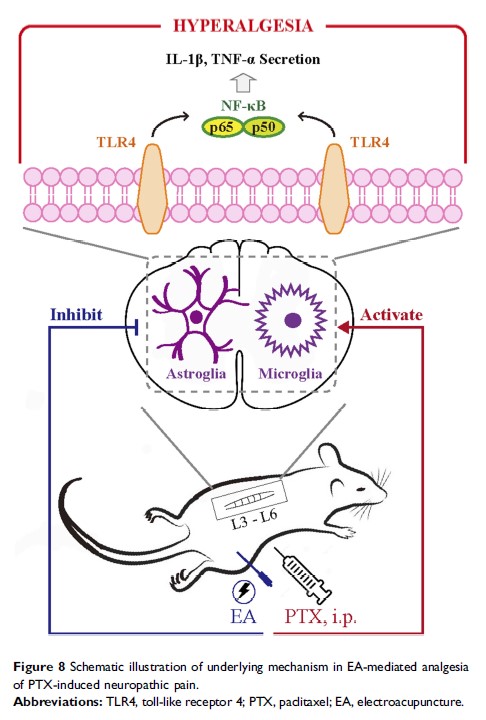
Background and Purpose: Neuropathic pain is a major side-effect of paclitaxel (PTX) chemotherapy. Although the precise mechanisms responsible for this pain are unclear, the activation of neuroglia and upregulation of the TLR4/NF-κB pathway are known to be involved. In this study, we determined whether electroacupuncture (EA) could limit mechanical hypersensitivity resulting from the chemotherapeutic drug PTX in rats, and investigated the potential mechanisms involved.
Methods: Rats intraperitoneally received a cumulative dose of 8 mg/kg PTX (2 mg/kg per day) or vehicle control on alternate days (day 0, 2, 4 and 6). EA treatment (10 Hz, 1 mA) was applied at bilateral ST36 acupoints in rats once every other day on days 0– 14. For sham EA, needles were inserted at ST36 acupoints without electrical stimulation. Mechanical allodynia was measured by mechanical withdrawal latency (MWL) of paws to a mechanical stimulus every 2 days. Protein expression of TLR4 and NF-κB p65, as well as TMEM119 and GFAP (indicators of microglia and astrocytes, respectively) in spinal cord was quantified by Western blot analysis. Levels of inflammatory cytokines IL-1β and TNF-α in spinal cord and serum were detected by ELISA.
Results: Mechanical allodynia induced by PTX in both paws (right and left) of rats was significantly attenuated by EA but not sham EA treatment. In addition, EA, but not sham EA, inhibited the activation of both microglia (TMEM119) and astrocytes (GFAP) in lumbar spinal cord. Moreover, Western blot analysis revealed that protein expression of TLR4 and NF-κB in spinal cord was suppressed by EA but not sham EA treatment. PTX significantly increased inflammatory cytokines in spinal cord and serum, which were ameliorated by EA treatment but not by sham EA.
Conclusion: These results indicate that EA treatment attenuates PTX-induced mechanical allodynia. The putative mechanism corroborating this finding could be related to the suppression of activated microglia and astrocytes in spinal cord, as well as the inhibition of the activated TLR4/NF-κB signaling pathway by EA treatment.
Keywords: electroacupuncture, neuropathic pain, paclitaxel, TLR4/NF-κB pathway, neuroglia