117745
论文已发表
注册即可获取德孚的最新动态
IF 收录期刊
- 3.6 Breast Cancer (Dove Med Press)
- 4.3 Clin Epidemiol
- 2.6 Cancer Manag Res
- 3.2 Infect Drug Resist
- 4.1 Clin Interv Aging
- 6.1 Drug Des Dev Ther
- 4.1 Int J Chronic Obstr
- 8.7 Int J Nanomed
- 2.5 Int J Women's Health
- 3.2 Neuropsych Dis Treat
- 2.4 OncoTargets Ther
- 2.6 Patient Prefer Adher
- 2.6 Ther Clin Risk Manag
- 3.1 J Pain Res
- 3.5 Diabet Metab Synd Ob
- 4.5 Psychol Res Behav Ma
- 3.4 Nat Sci Sleep
- 2.4 Pharmgenomics Pers Med
- 2.6 Risk Manag Healthc Policy
- 4.6 J Inflamm Res
- 2.3 Int J Gen Med
- 3.9 J Hepatocell Carcinoma
- 3.3 J Asthma Allergy
- 2.5 Clin Cosmet Investig Dermatol
- 3.0 J Multidiscip Healthc

经过十年医疗改革后,门诊患者满意度:十堰市三级医院的一项跨部门研究
Authors Ke L, Chen J, Jia J, Ke P, Chen X, Mao Z, Liu B
Received 4 October 2019
Accepted for publication 13 January 2020
Published 29 January 2020 Volume 2020:14 Pages 191—202
DOI https://doi.org/10.2147/PPA.S233472
Checked for plagiarism Yes
Review by Single-blind
Peer reviewer comments 2
Editor who approved publication: Dr Naifeng Liu
Purpose: This study aimed to evaluate outpatient satisfaction in tertiary hospitals in Shiyan, China, to predict which items had highest priorities for outpatient satisfaction, and to identify population groups on which the medical institutions should focus.
Patients and Methods: A cross-sectional survey was conducted at three tertiary hospitals in Shiyan city of China, from March to June 2018. An 18-item outpatient satisfaction questionnaire was applied. We conducted matrix analysis to describe the distribution of satisfaction score and the degree of influence of the items. Outpatient satisfaction was classified into the lowest and highest groups according to the 80/20 rule. Logistic regression model was used to identify demographic factors which might influence outpatient satisfaction.
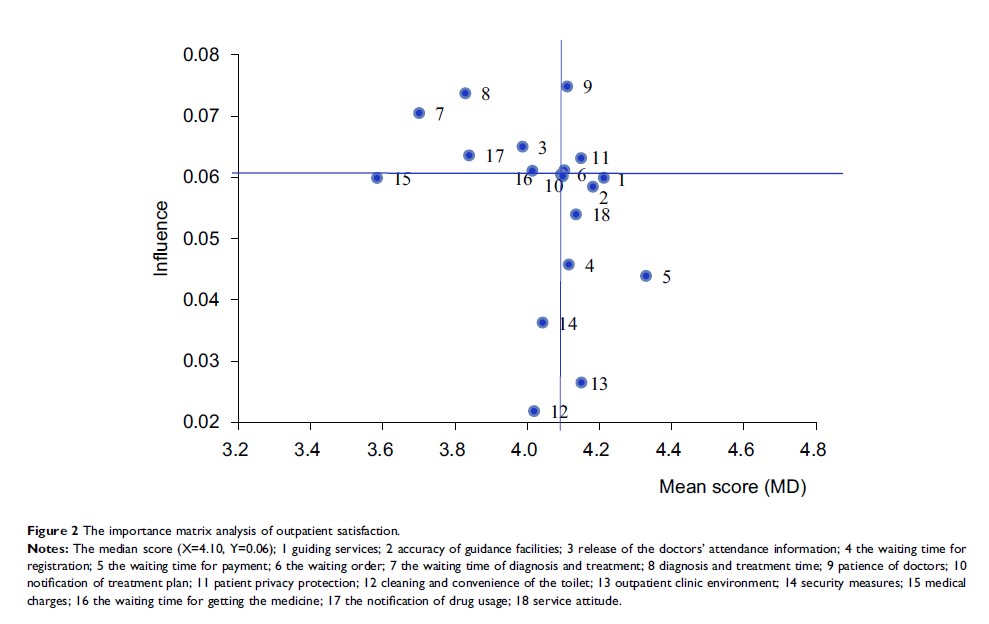
Results: A total of 2109 valid questionnaires were completed. The “waiting time”, “diagnosis and treatment time” and “medical charges” items showed relatively higher degrees of influence but earned lower levels of satisfaction. Outpatients with a college level or above educational background (AOR=1.36, 95% CI=1.03– 1.79) and with a family per-capita monthly income (FPMI)> 7000 CNY (AOR=3.30, 95% CI=1.60– 6.81) were more prevalent in the lowest satisfaction group. Outpatients with college level or above education background (COR=0.77, 95% CI=0.60– 0.99), FPMI of 3001– 5000 CNY (AOR=0.76, 95% CI=0.60– 0.96), non-local residents (AOR=1.48, 95% CI=1.07– 2.04), and urban workers with medical insurance (AOR=1.74, 95% CI=1.27– 2.39) were more prevalent in the highest satisfaction group.
Conclusion: The survey indicated that “long time to wait for treatment”, “short treatment time”, and “medical charges too expensive” were the top three aspects that need to be improved with priority by medical institutions. Education level, income level, residence and type of health insurance were the sociodemographic characteristics that significantly affect the outpatient satisfaction in tertiary hospitals. These factors need to be paid more attention by healthcare professionals to improve the patients’ satisfaction.
Keywords: outpatients’ satisfaction, tertiary hospitals, importance matrix analysis, the 80/20 rule