117745
论文已发表
注册即可获取德孚的最新动态
IF 收录期刊
- 3.6 Breast Cancer (Dove Med Press)
- 4.3 Clin Epidemiol
- 2.6 Cancer Manag Res
- 3.2 Infect Drug Resist
- 4.1 Clin Interv Aging
- 6.1 Drug Des Dev Ther
- 4.1 Int J Chronic Obstr
- 8.7 Int J Nanomed
- 2.5 Int J Women's Health
- 3.2 Neuropsych Dis Treat
- 2.4 OncoTargets Ther
- 2.6 Patient Prefer Adher
- 2.6 Ther Clin Risk Manag
- 3.1 J Pain Res
- 3.5 Diabet Metab Synd Ob
- 4.5 Psychol Res Behav Ma
- 3.4 Nat Sci Sleep
- 2.4 Pharmgenomics Pers Med
- 2.6 Risk Manag Healthc Policy
- 4.6 J Inflamm Res
- 2.3 Int J Gen Med
- 3.9 J Hepatocell Carcinoma
- 3.3 J Asthma Allergy
- 2.5 Clin Cosmet Investig Dermatol
- 3.0 J Multidiscip Healthc

L-酒石酸修饰的手性介孔二氧化硅纳米粒子作为药物载体的优越性:结构、润湿性、降解、生物粘附和生物相容性
Authors Hu B, Wang J, Li J, Li S, Li H
Received 7 October 2019
Accepted for publication 15 January 2020
Published 29 January 2020 Volume 2020:15 Pages 601—618
DOI https://doi.org/10.2147/IJN.S233740
Checked for plagiarism Yes
Review by Single-blind
Peer reviewer comments 2
Editor who approved publication: Dr Thomas Webster
Purpose: The purpose of this research was to study the basic physicochemical and biological properties regarding the application of L-tartaric acid modified chiral mesoporous silica nanoparticle (CMSN) as a drug carrier, and to explore the structure–property relationship of silica-based materials.
Methods: CMSN with functions of carboxyl modification and chirality was successfully synthesized through co-condensation method, and the basic characteristics of CMSN, including morphology, structure, wettability, degradation, bio-adhesion and retention ability in gastrointestinal tract (GI tract) were estimated by comparing with non-functionalized mesoporous silica nanoparticles (MSN). Meanwhile, the biocompatibility and toxicity of L-tartaric modification were systematically evaluated both in vitro and in vivo through MTT cell viability assay, cell cycle and apoptosis assay, hemolysis assay, histopathology examination, hematology analysis, and clinical chemistry examination.
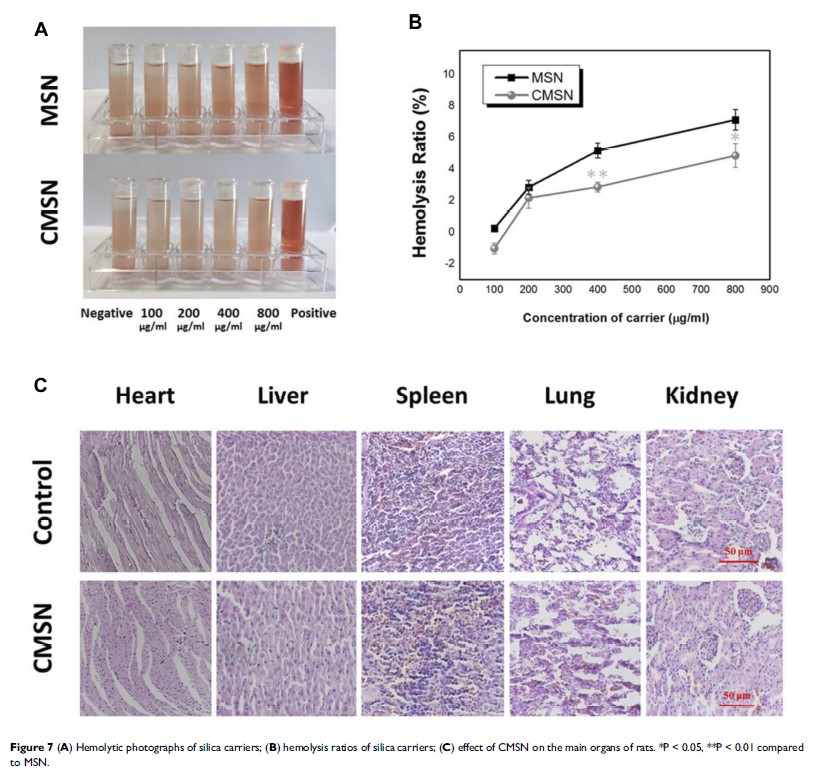
Results: CMSN and MSN were spherical nanoparticles with uniform mesoporous structure. CMSN with smaller pore size and carboxyl functional groups exhibited better wettability. Besides, CMSN and MSN could dissolve thoroughly in simulated physiological fluids during a degradation period of 1– 12 weeks. Interestingly, the in vitro and in vivo behaviors of carriers, including degradation, bio-adhesion and retention ability in the GI tract were closely related to wettability. As expected, CMSN had faster degradation rate, higher mucosa-adhesion ability, and longer retention time. Particularly, CMSN improved the bio-adhesion property in both gastric mucosa and small intestinal mucosa, and prolonged the GI tract retention time to at least 12 h, which meant higher probability for absorption. The biocompatibility and toxicity examination indicated that CMSN was a kind of biocompatible bio-material with good blood compatibility and negligible toxicity, which is required for further applications in biological fields.
Conclusion: CMSN with functions of carboxyl modification and chirality had superiority in terms of both physicochemical and biological properties. The in vitro and in vivo behaviors of carriers, including degradation, bio-adhesion, and retention were closely related to wettability.
Keywords: chiral mesoporous silica, carboxyl modification, wettability, bio-adhesion, biocompatibility