117806
论文已发表
注册即可获取德孚的最新动态
IF 收录期刊
- 3.6 Breast Cancer (Dove Med Press)
- 4.3 Clin Epidemiol
- 2.6 Cancer Manag Res
- 3.2 Infect Drug Resist
- 4.1 Clin Interv Aging
- 6.1 Drug Des Dev Ther
- 4.1 Int J Chronic Obstr
- 8.7 Int J Nanomed
- 2.5 Int J Women's Health
- 3.2 Neuropsych Dis Treat
- 2.4 OncoTargets Ther
- 2.6 Patient Prefer Adher
- 2.6 Ther Clin Risk Manag
- 3.1 J Pain Res
- 3.5 Diabet Metab Synd Ob
- 4.5 Psychol Res Behav Ma
- 3.4 Nat Sci Sleep
- 2.4 Pharmgenomics Pers Med
- 2.6 Risk Manag Healthc Policy
- 4.6 J Inflamm Res
- 2.3 Int J Gen Med
- 3.9 J Hepatocell Carcinoma
- 3.3 J Asthma Allergy
- 2.5 Clin Cosmet Investig Dermatol
- 3.0 J Multidiscip Healthc

用氧化锆纳米粒子进行预处理可减少由高致病性 H5N1 流感病毒引发的炎症
Authors Huo C, Xiao J, Xiao K, Zou S, Wang M, Qi P, Liu T, Hu Y
Received 2 July 2019
Accepted for publication 15 January 2020
Published 30 January 2020 Volume 2020:15 Pages 661—674
DOI https://doi.org/10.2147/IJN.S221667
Checked for plagiarism Yes
Review by Single-blind
Peer reviewer comments 2
Editor who approved publication: Dr Thomas Webster
Background: New approaches are urgently needed to fight influenza viral infection. Previous research has shown that zirconia nanoparticles can be used as anticancer materials, but their antiviral activity has not been reported. Here, we investigated the antiviral effect of zirconia (ZrO2) nanoparticles (NPs) against a highly pathogenic avian influenza virus.
Materials and Methods: In this study, the antiviral effects of ZrO2 on H5N1 virus were assessed in vivo, and the molecular mechanism responsible for this protection was investigated.
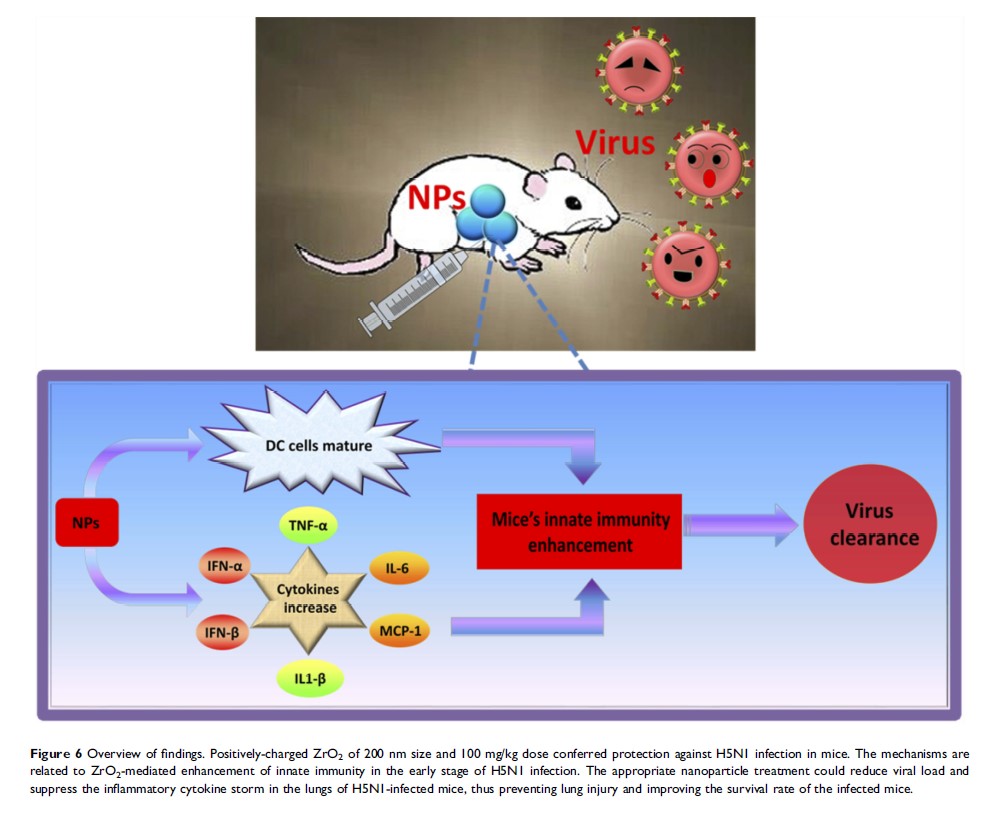
Results: Mice treated with 200 nm positively-charged NPs at a dose of 100 mg/kg showed higher survival rates and smaller reductions in weight. 200 nm ZrO2 activated mature dendritic cells and initially promoted the expression of cytokines associated with the antiviral response and innate immunity. In the lungs of H5N1-infected mice, ZrO2 treatment led to less pathological lung injury, significant reduction in influenza A virus replication, and overexpression of pro-inflammatory cytokines.
Conclusion: This antiviral study using zirconia NPs shows protection of mice against highly pathogenic avian influenza virus and suggests strong application potential for this method, introducing a new tool against a wide range of microbial infections.
Keywords: avian influenza virus, zirconia nanoparticles, cytokine storm, antiviral effect