117806
论文已发表
注册即可获取德孚的最新动态
IF 收录期刊
- 3.6 Breast Cancer (Dove Med Press)
- 4.3 Clin Epidemiol
- 2.6 Cancer Manag Res
- 3.2 Infect Drug Resist
- 4.1 Clin Interv Aging
- 6.1 Drug Des Dev Ther
- 4.1 Int J Chronic Obstr
- 8.7 Int J Nanomed
- 2.5 Int J Women's Health
- 3.2 Neuropsych Dis Treat
- 2.4 OncoTargets Ther
- 2.6 Patient Prefer Adher
- 2.6 Ther Clin Risk Manag
- 3.1 J Pain Res
- 3.5 Diabet Metab Synd Ob
- 4.5 Psychol Res Behav Ma
- 3.4 Nat Sci Sleep
- 2.4 Pharmgenomics Pers Med
- 2.6 Risk Manag Healthc Policy
- 4.6 J Inflamm Res
- 2.3 Int J Gen Med
- 3.9 J Hepatocell Carcinoma
- 3.3 J Asthma Allergy
- 2.5 Clin Cosmet Investig Dermatol
- 3.0 J Multidiscip Healthc

microRNA-182 可削弱爱佩琳对癫痫性神经元损伤的神经保护作用
Authors Dong H, Dong B, Zhang N, Liu S, Zhao H
Received 15 November 2019
Accepted for publication 21 January 2020
Published 30 January 2020 Volume 2020:16 Pages 327—338
DOI https://doi.org/10.2147/NDT.S238826
Checked for plagiarism Yes
Review by Single-blind
Peer reviewer comments 3
Editor who approved publication: Professor Yuping Ning
Purpose: To explore the neuroprotective effects and mechanisms of Apelin (APLN), and to study the regulation of APLN expression by microRNA (miRNA) in epilepsy.
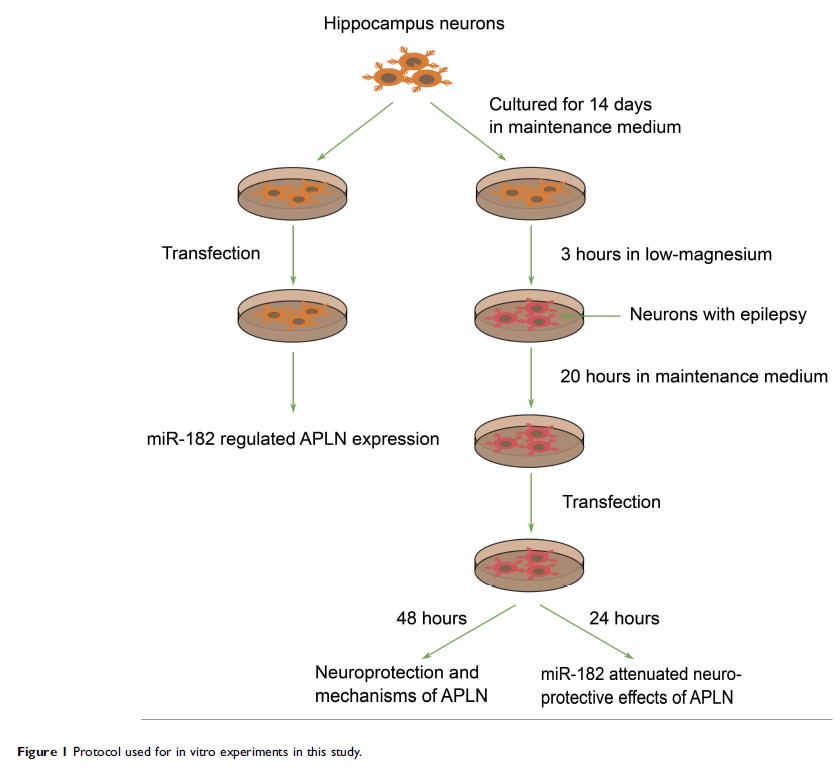
Materials and Methods: In vitro and in vivo epileptic models were established with hippocampal neurons and Wistar rats. Apoptosis of neurons was identified by flow cytometry. Western blotting was used to detect the expression of proteins, and quantitative reverse transcriptase polymerase chain reaction (qRT-PCR) was used to analyze the expression of miRNA and messenger RNA (mRNA). Bioinformatics software was used to predict target genes of miRNA, which were confirmed by dual-luciferase reporter gene system and functional experiments.
Results: Our study demonstrated protective effects of APLN against neuronal death in epilepsy both in vitro and in vivo. The underlying mechanisms involved are inhibiting the expression of metabotropic glutamate receptor 1 (mGluR1), Bax, and caspase-3; promoting the expression of Bcl-2; and increasing phosphorylated-AKT (p-AKT) levels in neurons. For the first time, we found that miR-182 could negatively regulate both transcriptional and translational levels of APLN, and that the up-regulation of miR-182 inhibited the expression of APLN and Bcl-2, and promoted the expression of Bax and caspase-3.
Conclusion: APLN could protect the neurons from injury in epilepsy by regulating the expression of apoptosis-associated proteins and mGluR1 and increasing p-AKT levels, which were attenuated by miR-182. Hence, miR-182/APLN may be potential targets for epilepsy control and treatment.
Keywords: epilepsy, apelin, neuroprotective effects, miR-182, regulation