114900
论文已发表
注册即可获取德孚的最新动态
IF 收录期刊
- 3.4 Breast Cancer (Dove Med Press)
- 3.2 Clin Epidemiol
- 2.6 Cancer Manag Res
- 2.9 Infect Drug Resist
- 3.7 Clin Interv Aging
- 5.1 Drug Des Dev Ther
- 3.1 Int J Chronic Obstr
- 6.6 Int J Nanomed
- 2.6 Int J Women's Health
- 2.9 Neuropsych Dis Treat
- 2.8 OncoTargets Ther
- 2.0 Patient Prefer Adher
- 2.2 Ther Clin Risk Manag
- 2.5 J Pain Res
- 3.0 Diabet Metab Synd Ob
- 3.2 Psychol Res Behav Ma
- 3.4 Nat Sci Sleep
- 1.8 Pharmgenomics Pers Med
- 2.0 Risk Manag Healthc Policy
- 4.1 J Inflamm Res
- 2.0 Int J Gen Med
- 3.4 J Hepatocell Carcinoma
- 3.0 J Asthma Allergy
- 2.2 Clin Cosmet Investig Dermatol
- 2.4 J Multidiscip Healthc

循环肿瘤细胞作为生物标记物可协助早期非小细胞肺癌的分子诊断
Authors He Y, Shi J, Schmidt B, Liu Q, Shi G, Xu X, Liu C, Gao Z, Guo T, Shan B
Received 3 December 2019
Accepted for publication 20 January 2020
Published 5 February 2020 Volume 2020:12 Pages 841—854
DOI https://doi.org/10.2147/CMAR.S240773
Checked for plagiarism Yes
Review by Single-blind
Peer reviewer comments 2
Editor who approved publication: Dr Eileen O'Reilly
Background and Objective: Compared with tissue biopsy, liquid biopsy is the most preferable non-invasive promising method in personalized medicine, although it has many limitations in isolating circulating tumor cells (CTC). Lung cancer associated mortality is drastically increased due to a shortfall of early-stage detection, which remains a challenge. Herein, we aimed to detect lung cancer at an early-stage using CellCollector device.
Methods: 39,627 volunteers underwent low-dose computed tomography; 2508 cases with pulmonary nodules and 7080 with no pulmonary nodules were chosen. After follow-up, 24 patients were diagnosed with early-stage non-small cell lung cancer (NSCLC), and subjected to CTC detection using CellCollector, along with 72 healthy volunteers. Immunofluorescence staining for EpCAM/CKs and CD45 were performed for CTC validation.
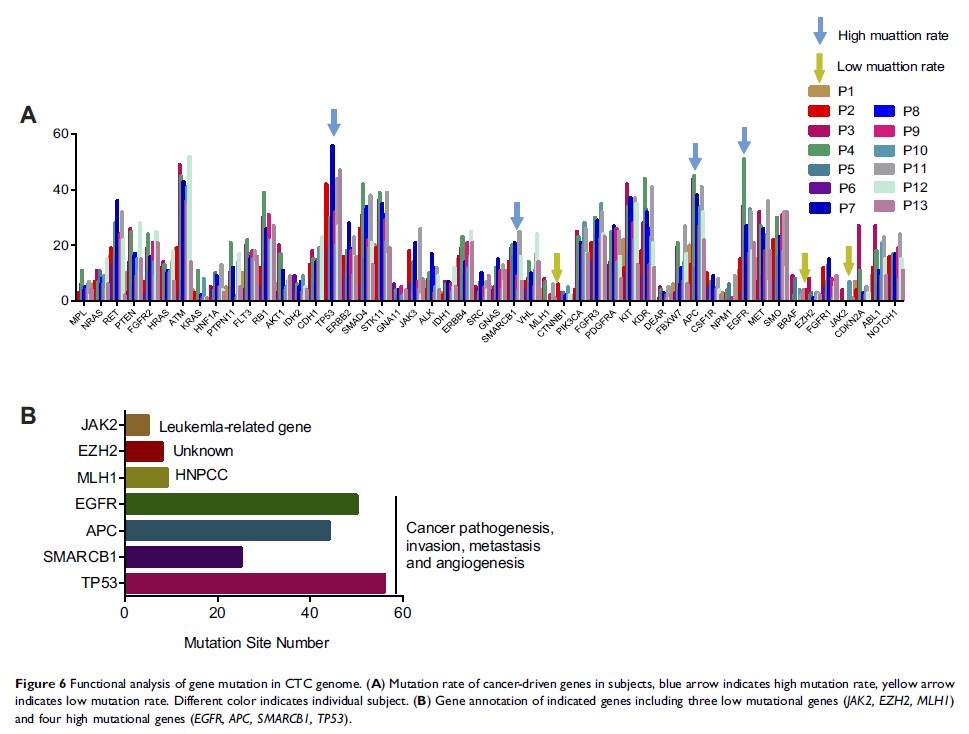
Results: Fifteen out of twenty-four (stage I, n = 18; stage II, n = 6) early-stage lung cancer patients were found to be CTC-positive, whereas no CTC was found in the control group. Genetic mutation of TP53, ERBB2, PDGFRA, CFS1R and FGFR1 in the CTC revealed 71.6% of the mutation sites similar to the tumor tissues of 13 patients. Molecular characterization revealed higher expression of protein PD-LI in CTC (40%) as compared to tumor tissue (26.7%). Moreover, CTC clusters were detected in 40% of patients.
Conclusion: CTC detection using the CellCollector in early-stage NSCLC had a relative high capture rate. Moreover, CTC analysis is a prospective setting for molecular diagnostic in cases when tumor tissue biopsy is not desirable.
Keywords: CellCollector, in vivo detection, PD-L1, gene mutation, next generation sequencing