114900
论文已发表
注册即可获取德孚的最新动态
IF 收录期刊
- 3.4 Breast Cancer (Dove Med Press)
- 3.2 Clin Epidemiol
- 2.6 Cancer Manag Res
- 2.9 Infect Drug Resist
- 3.7 Clin Interv Aging
- 5.1 Drug Des Dev Ther
- 3.1 Int J Chronic Obstr
- 6.6 Int J Nanomed
- 2.6 Int J Women's Health
- 2.9 Neuropsych Dis Treat
- 2.8 OncoTargets Ther
- 2.0 Patient Prefer Adher
- 2.2 Ther Clin Risk Manag
- 2.5 J Pain Res
- 3.0 Diabet Metab Synd Ob
- 3.2 Psychol Res Behav Ma
- 3.4 Nat Sci Sleep
- 1.8 Pharmgenomics Pers Med
- 2.0 Risk Manag Healthc Policy
- 4.1 J Inflamm Res
- 2.0 Int J Gen Med
- 3.4 J Hepatocell Carcinoma
- 3.0 J Asthma Allergy
- 2.2 Clin Cosmet Investig Dermatol
- 2.4 J Multidiscip Healthc

三七通过靶向 STZ 诱导的糖尿病大鼠中的 Wnt/β-连环蛋白信号传导途径改善足细胞上皮间质转分化
Authors Xie L, Zhai R, Chen T, Gao C, Xue R, Wang N, Wang J, Xu Y, Gui D
Received 21 October 2019
Accepted for publication 19 January 2020
Published 5 February 2020 Volume 2020:14 Pages 527—538
DOI https://doi.org/10.2147/DDDT.S235491
Checked for plagiarism Yes
Review by Single-blind
Peer reviewer comments 3
Editor who approved publication: Professor Jianbo Sun
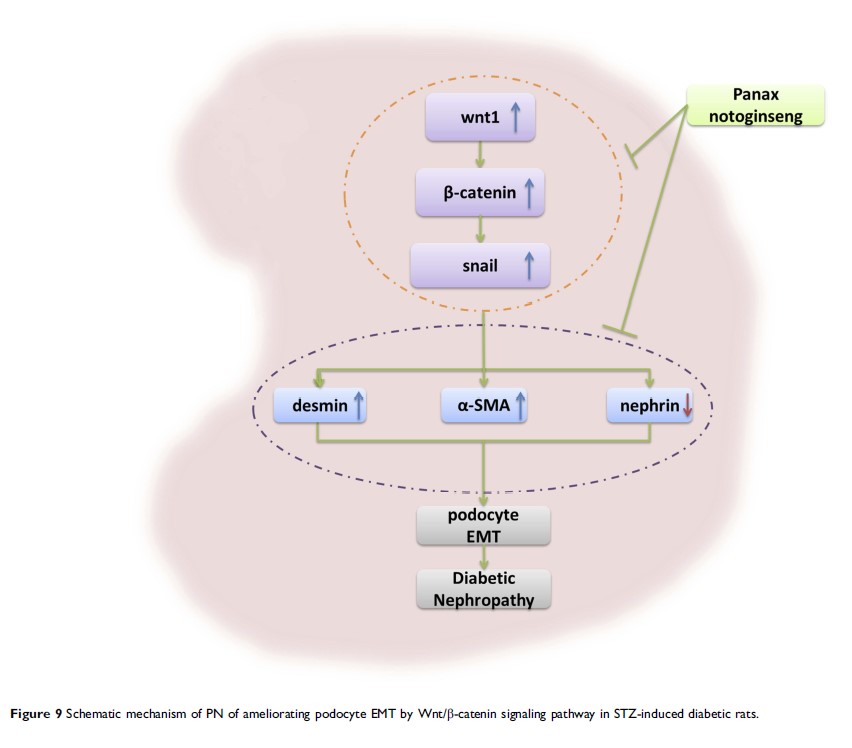
Introduction: Epithelial–mesenchymal transition (EMT) may contribute to podocyte dysfunction in diabetic nephropathy (DN). Aiming to identify novel therapeutic options, we investigated the protective effects of Panax notoginseng (PN) on podocyte EMT in diabetic rats and explored its mechanisms.
Methods: Diabetes was induced in rats with streptozotocin (STZ) by intraperitoneal injection at 55 mg/kg. Diabetic rats were randomly divided into three groups, namely, diabetic rats, diabetic rats treated with beraprost sodium (BPS) at 0.6 mg/kg/d or PN at 0.4 g/kg/d p.o., for 12 weeks. Urinary albumin/creatinine ratio (ACR), biochemical parameters, renal histopathology, and podocyte morphological changes were evaluated. Protein expression of EMT markers (desmin, α-SMA, and nephrin) as well as components of the Wnt/β-catenin pathway (wnt1, β-catenin, and snail) was detected by immunohistochemistry and Western blot, respectively.
Results: In diabetic rats, severe hyperglycemia and albuminuria were detected. Moreover, mesangial expansion and podocyte foot process effacement were found markedly increased in diabetic kidneys. Increased protein expression of wnt1, β-catenin, snail, desmin, and α-SMA, as well as decreased protein expression of nephrin was detected in diabetic kidneys. All these abnormalities found in DN rats were partially restored by PN treatment.
Conclusion: PN ameliorated albuminuria and podocyte EMT in diabetic rats partly through inhibiting Wnt/β-catenin signaling pathway. These findings provide experimental arguments for a novel therapeutic option in DN.
Keywords: Panax notoginseng, diabetic nephropathy, podocyte, Wnt/β-catenin, epithelial–mesenchymal transition