115195
论文已发表
注册即可获取德孚的最新动态
IF 收录期刊
- 3.6 Breast Cancer (Dove Med Press)
- 4.3 Clin Epidemiol
- 2.6 Cancer Manag Res
- 3.2 Infect Drug Resist
- 4.1 Clin Interv Aging
- 6.1 Drug Des Dev Ther
- 4.1 Int J Chronic Obstr
- 8.7 Int J Nanomed
- 2.5 Int J Women's Health
- 3.2 Neuropsych Dis Treat
- 2.4 OncoTargets Ther
- 2.6 Patient Prefer Adher
- 2.6 Ther Clin Risk Manag
- 3.1 J Pain Res
- 3.5 Diabet Metab Synd Ob
- 4.5 Psychol Res Behav Ma
- 3.4 Nat Sci Sleep
- 2.4 Pharmgenomics Pers Med
- 2.6 Risk Manag Healthc Policy
- 4.6 J Inflamm Res
- 2.3 Int J Gen Med
- 3.9 J Hepatocell Carcinoma
- 3.3 J Asthma Allergy
- 2.5 Clin Cosmet Investig Dermatol
- 3.0 J Multidiscip Healthc

肝动脉输注奥沙利铂结合口服化疗药物 S-1 治疗无法切除的肝转移胃癌:病例报告和文献回顾
Authors Wang K, Zhang X, Wei J, Xu Y, Liu Q, Xie J, Yuan L, Sun Z, Tan S, Zhang L, Liu B, Yang Y
Received 1 October 2019
Accepted for publication 10 January 2020
Published 7 February 2020 Volume 2020:12 Pages 863—870
DOI https://doi.org/10.2147/CMAR.S233123
Checked for plagiarism Yes
Review by Single-blind
Peer reviewer comments 2
Editor who approved publication: Dr Antonella D'Anneo
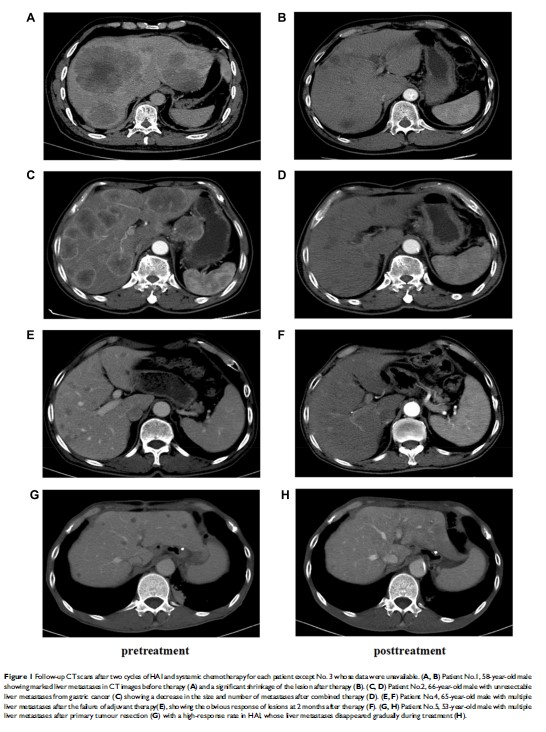
Objective: The use of hepatic artery infusion (HAI) as a regional therapy against liver metastasis has rarely been reported in gastric cancer. This study aimed to evaluate the efficacy and safety of HAI oxaliplatin plus oral S-1 chemotherapy in first-line palliative therapy for gastric cancer with multiple liver metastases (GCLM).
Methods: We reviewed the records of five patients with GCLM who received HAI oxaliplatin (70– 80 mg/m2 2 hrs d1,15) administered via a port-catheter system and S-1 with oral (35– 40 mg/m2 twice daily for d1-14, 28 days for one cycle). Follow-up examination and efficacy evaluation were executed periodically.
Results: Until the 4th cycle response evaluation, the local effective rate and control rate were 40% and 80%, respectively; only one patient developed progression. HAI chemotherapy had a better local control against liver metastases (median progression-free survival: hepatic, 8.8 months vs. extrahepatic, 6.2 months), accompanied by less systemic toxicity, decreased tumour markers and symptomatic relief.
Conclusion: HAI oxaliplatin plus oral S-1 chemotherapy can be considered as a new choice of first-line treatment for GCLM, which is also a good approach for controlling extrahepatic lesions with less adverse events.
Keywords: gastric cancer with multiple liver metastases, nonresectional regional therapy, hepatic arterial infusion, port-catheter system, response evaluation, adverse events