114900
论文已发表
注册即可获取德孚的最新动态
IF 收录期刊
- 3.4 Breast Cancer (Dove Med Press)
- 3.2 Clin Epidemiol
- 2.6 Cancer Manag Res
- 2.9 Infect Drug Resist
- 3.7 Clin Interv Aging
- 5.1 Drug Des Dev Ther
- 3.1 Int J Chronic Obstr
- 6.6 Int J Nanomed
- 2.6 Int J Women's Health
- 2.9 Neuropsych Dis Treat
- 2.8 OncoTargets Ther
- 2.0 Patient Prefer Adher
- 2.2 Ther Clin Risk Manag
- 2.5 J Pain Res
- 3.0 Diabet Metab Synd Ob
- 3.2 Psychol Res Behav Ma
- 3.4 Nat Sci Sleep
- 1.8 Pharmgenomics Pers Med
- 2.0 Risk Manag Healthc Policy
- 4.1 J Inflamm Res
- 2.0 Int J Gen Med
- 3.4 J Hepatocell Carcinoma
- 3.0 J Asthma Allergy
- 2.2 Clin Cosmet Investig Dermatol
- 2.4 J Multidiscip Healthc

TKIs 治疗的转移性肾细胞癌患者体内脂肪成分的预后价值
Authors Dai J, Zhang X, Liu Z, Song T, Zhu X, Zhang H, Wu M, Li X, Zeng H, Shen P
Received 13 September 2019
Accepted for publication 24 December 2019
Published 7 February 2020 Volume 2020:12 Pages 891—903
DOI https://doi.org/10.2147/CMAR.S230973
Checked for plagiarism Yes
Review by Single-blind
Peer reviewer comments 2
Editor who approved publication: Dr Eileen O'Reilly
Purpose: To assess the association between body fat components and survival status and tumor response for metastatic renal cell carcinoma (mRCC) patients treated with tyrosine kinase inhibitors (TKIs).
Patients and Methods: Patients with pathologically diagnosed and radiologically indicated mRCC were enrolled into the retrospective study. Three body fat components: total fat accumulation (TFA), visceral fat accumulation (VFA) and subcutaneous fat accumulation (SFA) were measured using standard CT scans. The clinical outcomes included progression-free survival (PFS), overall survival (OS), and tumor response rates. Univariate analysis and multivariate Cox proportion hazard regression models were used to find associated parameters and to calculate the adjusted hazard ratio (HR).
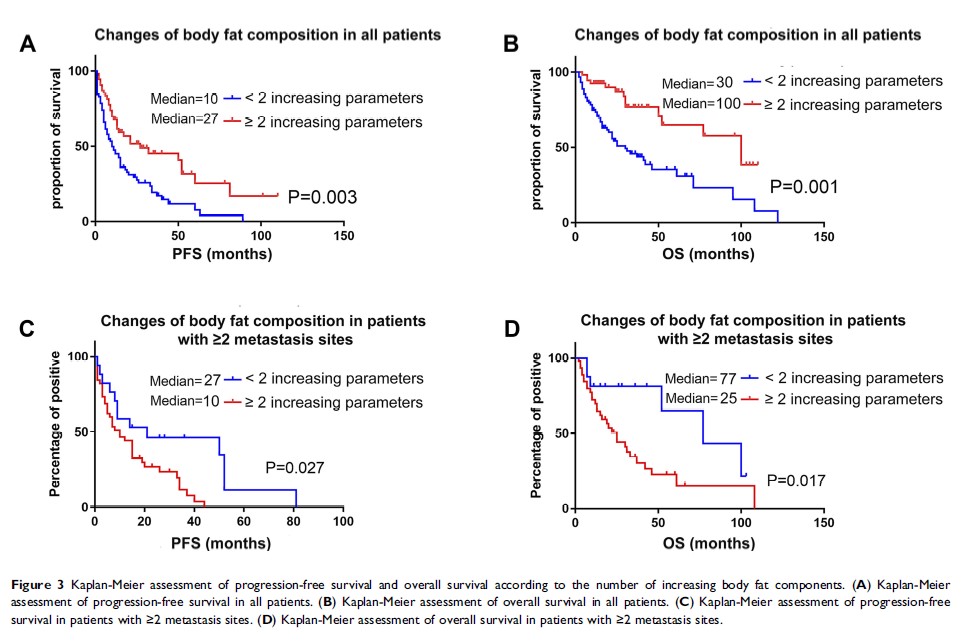
Results: A total of 146 patients were enrolled and the average age of patients was 56.5 years old. According to the univariate analysis, patients with an increased SFA and TFA had a longer PFS and OS. A similar phenomenon was observed among patients with ≥ 2 increasing body fat components about PFS and OS. As for multivariate analysis, SFA change (p=0.014) or the number of increasing body fat components (p=0.040) were independent indicators to predict PFS. In addition, SFA change (p=0.022) or the number of increasing body fat components (p=0.008) could independently predict OS. Moreover, a better disease control rate (p=0.028) was founded in patients with ≥ 2 increasing components. In the subgroup of patients with ≥ 2 metastasis sites, improved OS (p=0.017) and PFS (p=0.027) were found compared to those with < 2 increasing components. Further multivariate analysis identified the number of increasing body fat components was an independent factor in predicting PFS (p=0.018) and OS (p=0.029).
Conclusion: Body fat accumulation, such as high SFA or TFA at progression, could improve the survival of patients with mRCC treated with TKIs, especially patients with higher tumor burden. It should be considered as an important parameter to predict the survival status of patients with mRCC.
Keywords: tyrosine kinase inhibitor, body fat component, prognosis