114900
论文已发表
注册即可获取德孚的最新动态
IF 收录期刊
- 3.4 Breast Cancer (Dove Med Press)
- 3.2 Clin Epidemiol
- 2.6 Cancer Manag Res
- 2.9 Infect Drug Resist
- 3.7 Clin Interv Aging
- 5.1 Drug Des Dev Ther
- 3.1 Int J Chronic Obstr
- 6.6 Int J Nanomed
- 2.6 Int J Women's Health
- 2.9 Neuropsych Dis Treat
- 2.8 OncoTargets Ther
- 2.0 Patient Prefer Adher
- 2.2 Ther Clin Risk Manag
- 2.5 J Pain Res
- 3.0 Diabet Metab Synd Ob
- 3.2 Psychol Res Behav Ma
- 3.4 Nat Sci Sleep
- 1.8 Pharmgenomics Pers Med
- 2.0 Risk Manag Healthc Policy
- 4.1 J Inflamm Res
- 2.0 Int J Gen Med
- 3.4 J Hepatocell Carcinoma
- 3.0 J Asthma Allergy
- 2.2 Clin Cosmet Investig Dermatol
- 2.4 J Multidiscip Healthc

Applying Serum Cytokine Levels to Predict Pain Severity in Cancer Patients
Authors Fazzari J, Sidhu J, Motkur S, Inman M, Buckley N, Clemons M, Vandermeer L, Singh G
Received 14 August 2019
Accepted for publication 20 January 2020
Published 7 February 2020 Volume 2020:13 Pages 313—321
DOI https://doi.org/10.2147/JPR.S227175
Checked for plagiarism Yes
Review by Single-blind
Peer reviewer comments 2
Editor who approved publication: Dr Michael E Schatman
Background and Aim: Cancers originating in the breast, lung and prostate often metastasize to the bone, frequently resulting in cancer-induced bone pain that can be challenging to manage despite conventional analgesic therapy. This exploratory study’s aim was to identify potential biomarkers associated with cancer-induced pain by examining a sample population of breast cancer patients undergoing bisphosphonate therapy.
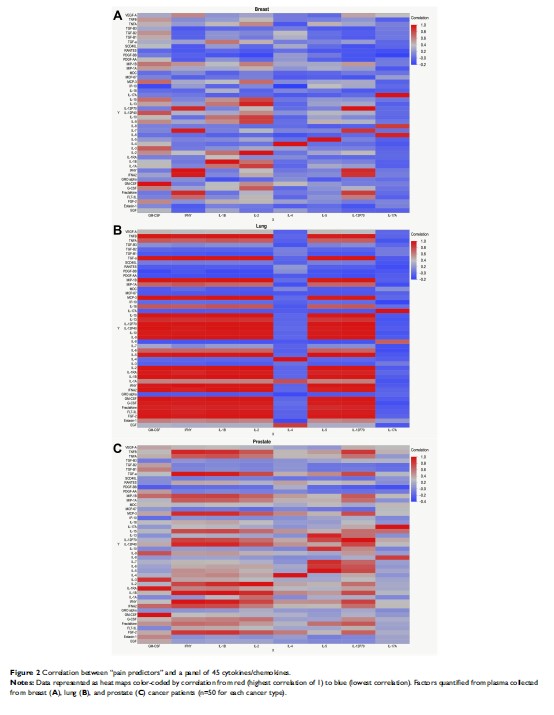
Methods: A secondary analysis of the primary study was performed to quantify serum cytokine levels for correlation to pain scores. Cytokines with statistically significant correlations were then input into a stepwise regression analysis to generate a predictive equation for a patient’s pain severity. In an effort to find additional potential biomarkers, correlation analysis was performed between these factors and a more comprehensive panel of cytokines and chemokines from breast, lung, and prostate cancer patients.
Results: Statistical analysis identified nine cytokines (GM-CSF, IFNγ, IL-1β, IL-2, IL-4, IL-5, IL-12p70, IL-17A, and IL-23) that had significant negative correlations with pain scores and they could best predict pain severity through a predictive equation generated for this specific evaluation. After performing a correlation analysis between these factors and a larger panel of cytokines and chemokines, samples from breast, lung and prostate patients showed distinct correlation profiles, highlighting the clinical challenge of applying pain-associated cytokines related to more defined nociceptive states, such as arthritis, to a cancer pain state.
Conclusion: Exploratory analyses such as the ones presented here will be a beneficial tool to expand insights into potential cancer-specific nociceptive mechanisms and to develop novel therapeutics.
Keywords: biomarkers, cancer-induced pain, nociception, immune factors