114900
论文已发表
注册即可获取德孚的最新动态
IF 收录期刊
- 3.4 Breast Cancer (Dove Med Press)
- 3.2 Clin Epidemiol
- 2.6 Cancer Manag Res
- 2.9 Infect Drug Resist
- 3.7 Clin Interv Aging
- 5.1 Drug Des Dev Ther
- 3.1 Int J Chronic Obstr
- 6.6 Int J Nanomed
- 2.6 Int J Women's Health
- 2.9 Neuropsych Dis Treat
- 2.8 OncoTargets Ther
- 2.0 Patient Prefer Adher
- 2.2 Ther Clin Risk Manag
- 2.5 J Pain Res
- 3.0 Diabet Metab Synd Ob
- 3.2 Psychol Res Behav Ma
- 3.4 Nat Sci Sleep
- 1.8 Pharmgenomics Pers Med
- 2.0 Risk Manag Healthc Policy
- 4.1 J Inflamm Res
- 2.0 Int J Gen Med
- 3.4 J Hepatocell Carcinoma
- 3.0 J Asthma Allergy
- 2.2 Clin Cosmet Investig Dermatol
- 2.4 J Multidiscip Healthc

在新辅助化疗后使用融合腋窝超声的新模型来预测浸润性乳腺癌的非前哨淋巴结转移
Authors Zhang K, Zhu Q, Sheng D, Li J, Chang C
Received 25 November 2019
Accepted for publication 29 January 2020
Published 10 February 2020 Volume 2020:12 Pages 965—972
DOI https://doi.org/10.2147/CMAR.S239921
Checked for plagiarism Yes
Review by Single-blind
Peer reviewer comments 2
Editor who approved publication: Dr Antonella D'Anneo
Purpose: Few models with good discriminative power have been introduced to predict the risk of non-sentinel lymph node (non-SLN) metastasis in breast cancer after neoadjuvant chemotherapy (NAC). We aimed to develop a new and simple model for predicting the probability of non-SLN metastasis in breast cancer and facilitate the selection of patients who could avoid unnecessary axillary lymph node dissection following NAC.
Patients and Methods: A total of 298 patients diagnosed with invasive breast cancer, who underwent SLN biopsy after completing NAC and subsequently breast surgery, were included and classified into the training set (n=228) and testing set (n=70). Univariate and multivariate analyses were used to select factors that could be determined prior to breast surgery and significantly correlated with non-SLN metastasis in the training set. A logistic regression model was developed based on these factors and validated in the testing set.
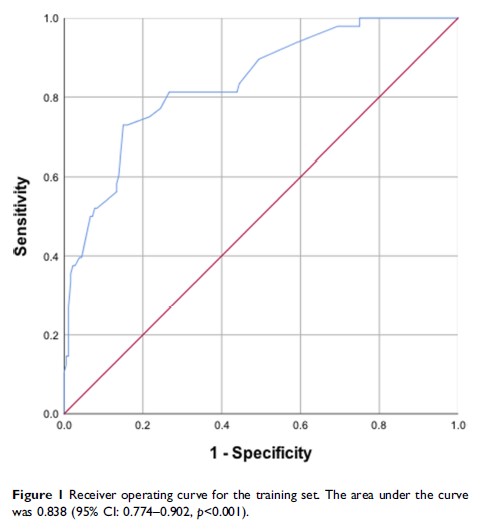
Results: Nodal status before NAC, post-NAC axillary ultrasound status, SLN number, and SLN metastasis number were independent predictors of non-SLN metastases in breast cancer after NAC. A predictive model based on these factors yielded an area under the curve of 0.838 (95% confidence interval: 0.774– 0.902, p < 0.001) in the training set. When applied to the testing set, this model yielded an area under the curve of 0.808 (95% confidence interval: 0.609– 1.000, p = 0.003).
Conclusion: A new and simple model, which incorporated factors that could be determined prior to breast surgery, was developed to predict non-SLN metastasis in invasive breast cancer following NAC. Although this model performed excellently in internal validation, it requires external validation before it can be widely utilized in the clinical setting.
Keywords: breast carcinoma, neoadjuvant chemotherapy, sentinel lymph node, ultrasonography