114627
论文已发表
注册即可获取德孚的最新动态
IF 收录期刊
- 3.4 Breast Cancer (Dove Med Press)
- 3.2 Clin Epidemiol
- 2.6 Cancer Manag Res
- 2.9 Infect Drug Resist
- 3.7 Clin Interv Aging
- 5.1 Drug Des Dev Ther
- 3.1 Int J Chronic Obstr
- 6.6 Int J Nanomed
- 2.6 Int J Women's Health
- 2.9 Neuropsych Dis Treat
- 2.8 OncoTargets Ther
- 2.0 Patient Prefer Adher
- 2.2 Ther Clin Risk Manag
- 2.5 J Pain Res
- 3.0 Diabet Metab Synd Ob
- 3.2 Psychol Res Behav Ma
- 3.4 Nat Sci Sleep
- 1.8 Pharmgenomics Pers Med
- 2.0 Risk Manag Healthc Policy
- 4.1 J Inflamm Res
- 2.0 Int J Gen Med
- 3.4 J Hepatocell Carcinoma
- 3.0 J Asthma Allergy
- 2.2 Clin Cosmet Investig Dermatol
- 2.4 J Multidiscip Healthc

在病理性剪切应力作用下,通过多种结合机制,血小板膜包裹的纳米颗粒可靶向 ApoE−/− 小鼠的钙化性主动脉瓣
Authors Yang H, Song Y, Chen J, Pang Z, Zhang N, Cao J, Wang Q, Li Q, Zhang F, Dai Y, Li C, Huang Z, Qian J, Ge J
Received 21 July 2019
Accepted for publication 9 January 2020
Published 10 February 2020 Volume 2020:15 Pages 901—912
DOI https://doi.org/10.2147/IJN.S224024
Checked for plagiarism Yes
Review by Single-blind
Peer reviewer comments 2
Editor who approved publication: Dr Linlin Sun
Background: Aortic valve disease is the most common valvular heart disease leading to valve replacement. The efficacy of pharmacological therapy for aortic valve disease is limited by the high mechanical stress at the aortic valves impairing the binding rate. We aimed to identify nanoparticle coating with entire platelet membranes to fully mimic their inherent multiple adhesive mechanisms and target the sclerotic aortic valve of apolipoprotein E-deficient (ApoE−/−) mice based on their multiple sites binding capacity under high shear stress.
Methods: Considering the potent interaction of platelet membrane glycoproteins with components present in sclerotic aortic valves, platelet membrane-coated nanoparticles (PNPs) were synthetized and the binding capacity under high shear stress was evaluated in vitro and in vivo.
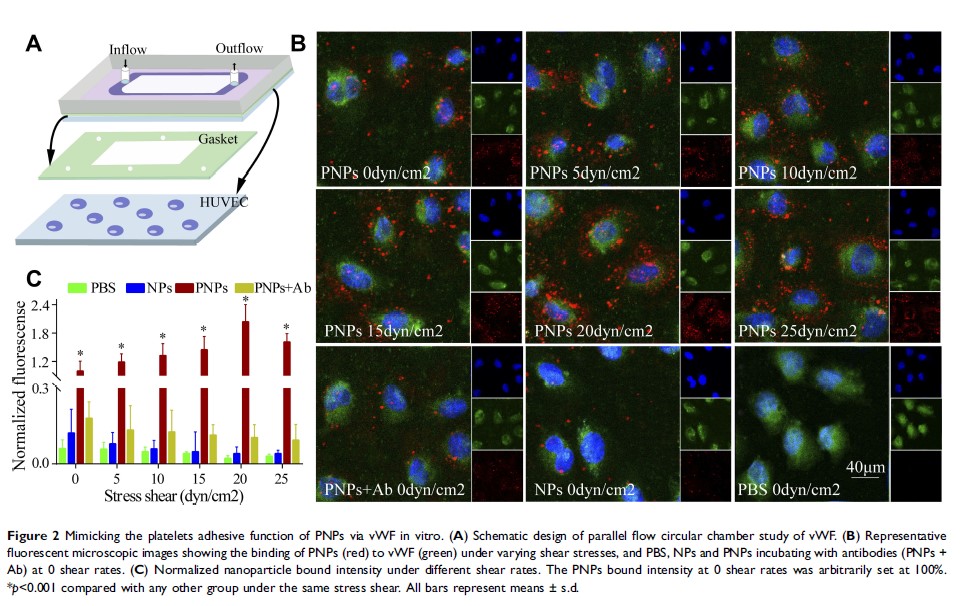
Results: PNPs demonstrated effectively adhering to von Willebrand factor, collagen and fibrin under shear stresses in vitro. In an aortic valve disease model established in ApoE−/− mice, PNPs exhibited good targeting to sclerotic aortic valves by mimicking platelet multiple adhesive mechanisms.
Conclusion: PNPs could provide a promising platform for the molecular diagnosis and targeting treatment of aortic valve disease.
Keywords: aortic valve, atherosclerosis, platelet membrane, nanoparticle, targeting