114627
论文已发表
注册即可获取德孚的最新动态
IF 收录期刊
- 3.4 Breast Cancer (Dove Med Press)
- 3.2 Clin Epidemiol
- 2.6 Cancer Manag Res
- 2.9 Infect Drug Resist
- 3.7 Clin Interv Aging
- 5.1 Drug Des Dev Ther
- 3.1 Int J Chronic Obstr
- 6.6 Int J Nanomed
- 2.6 Int J Women's Health
- 2.9 Neuropsych Dis Treat
- 2.8 OncoTargets Ther
- 2.0 Patient Prefer Adher
- 2.2 Ther Clin Risk Manag
- 2.5 J Pain Res
- 3.0 Diabet Metab Synd Ob
- 3.2 Psychol Res Behav Ma
- 3.4 Nat Sci Sleep
- 1.8 Pharmgenomics Pers Med
- 2.0 Risk Manag Healthc Policy
- 4.1 J Inflamm Res
- 2.0 Int J Gen Med
- 3.4 J Hepatocell Carcinoma
- 3.0 J Asthma Allergy
- 2.2 Clin Cosmet Investig Dermatol
- 2.4 J Multidiscip Healthc

通过 DNMT1 活性沉默,对 MCF-7 细胞中 6-硫鸟嘌呤的肿瘤抑制信号通路进行转录组学分析
Authors Li H, An X, Zhang D, Li Q, Zhang N, Yu H, Li Z
Received 29 October 2019
Accepted for publication 24 January 2020
Published 11 February 2020 Volume 2020:13 Pages 1211—1223
DOI https://doi.org/10.2147/OTT.S236543
Checked for plagiarism Yes
Review by Single-blind
Peer reviewer comments 2
Editor who approved publication: Dr Sanjeev Srivastava
Background: 6-thioguanine (6-TG), as a conventional “ancient” drug for the treatment of acute leukemia, has been proved to have extensive anti-tumor roles. This study was created to investigate the hidden function of 6-TG on the MCF-7 breast cancer cell line (ER+, PR+) and its mechanisms.
Methods: MCF-7 cells were treated with 6-TG, and the IC50 value was measured by a cell counting kit-8 assay. Differentially expressed genes (DEGs) were confirmed by RNA-seq analysis. Apoptosis and cell cycle consequences were determined by flow cytometry and Western blot analyses.
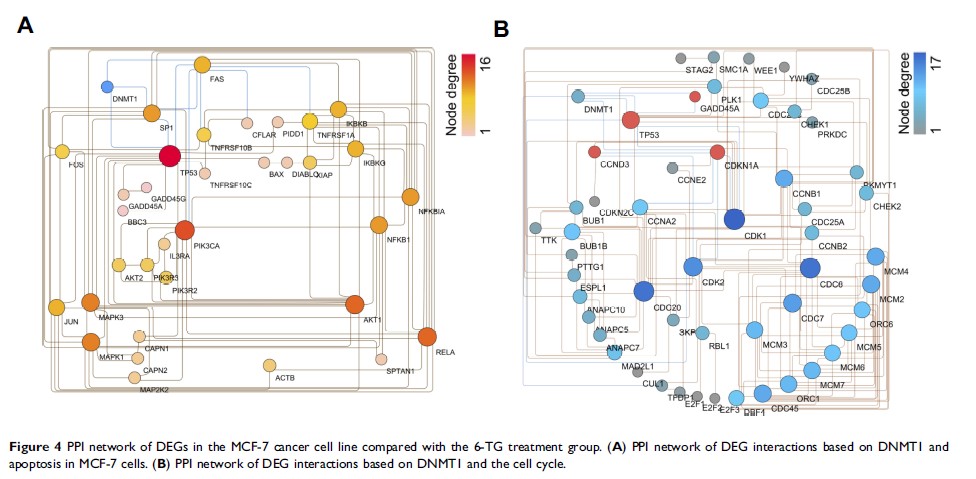
Results: The results showed that colony formation decreased markedly and the percentage of cell apoptosis increased after 6-TG treatment. DNMT1 mRNA and protein expression decreased, and FAS expression increased. Moreover, 6-TG also induced MCF-7 cells to undergo G2/M phase cell cycle arrest and upregulated CDKN1A (p21).
Conclusion: Overall, our results suggest that 6-TG may induce FAS-mediated exogenous apoptosis and p21-dependent G2/M arrest by inhibiting the activity of DNMT1 in MCF-7 breast cancer cells.
Keywords: 6-TG, MCF-7 breast cancer cells, apoptosis, cell cycle, DNMT1