114627
论文已发表
注册即可获取德孚的最新动态
IF 收录期刊
- 3.4 Breast Cancer (Dove Med Press)
- 3.2 Clin Epidemiol
- 2.6 Cancer Manag Res
- 2.9 Infect Drug Resist
- 3.7 Clin Interv Aging
- 5.1 Drug Des Dev Ther
- 3.1 Int J Chronic Obstr
- 6.6 Int J Nanomed
- 2.6 Int J Women's Health
- 2.9 Neuropsych Dis Treat
- 2.8 OncoTargets Ther
- 2.0 Patient Prefer Adher
- 2.2 Ther Clin Risk Manag
- 2.5 J Pain Res
- 3.0 Diabet Metab Synd Ob
- 3.2 Psychol Res Behav Ma
- 3.4 Nat Sci Sleep
- 1.8 Pharmgenomics Pers Med
- 2.0 Risk Manag Healthc Policy
- 4.1 J Inflamm Res
- 2.0 Int J Gen Med
- 3.4 J Hepatocell Carcinoma
- 3.0 J Asthma Allergy
- 2.2 Clin Cosmet Investig Dermatol
- 2.4 J Multidiscip Healthc

miR-183-5p 调节对于可由紫草素抑制的、snail 介导下的宫颈癌细胞上皮-间质转化的影响
Authors Tang Q, Liu L, Zhang H, Xiao J, Hann SS
Received 26 October 2019
Accepted for publication 29 January 2020
Published 11 February 2020 Volume 2020:14 Pages 577—589
DOI https://doi.org/10.2147/DDDT.S236216
Checked for plagiarism Yes
Review by Single-blind
Peer reviewer comments 2
Editor who approved publication: Dr Qiongyu Guo
Background: Shikonin, the main ingredient of Lithospermum erythrorhizon , has been reported to have antitumor effects via multiple targets and signaling pathways. However, the detailed mechanism underlying the effects in cervical cancer still remained unknown.
Methods: MTT, wound-healing, transwell assays and flow cytometry experiments were used to measure cell growth, migration, invasion, and cell cycle analysis. Western blot was used to examine protein levels of Snail, Vimentin and E-cadherin. The expression level of miR-183-5p was measured via qRT-PCR. The E-cadherin promoter activity was detected via Secrete-PairTM Dual Luminescence Assay Kit. The transient transfection experiments were used for silencing of E-cadherin and overexpression of Snail genes. Tumor xenograft and bioluminescent imaging experiments were carried out to confirm the in vitro findings.
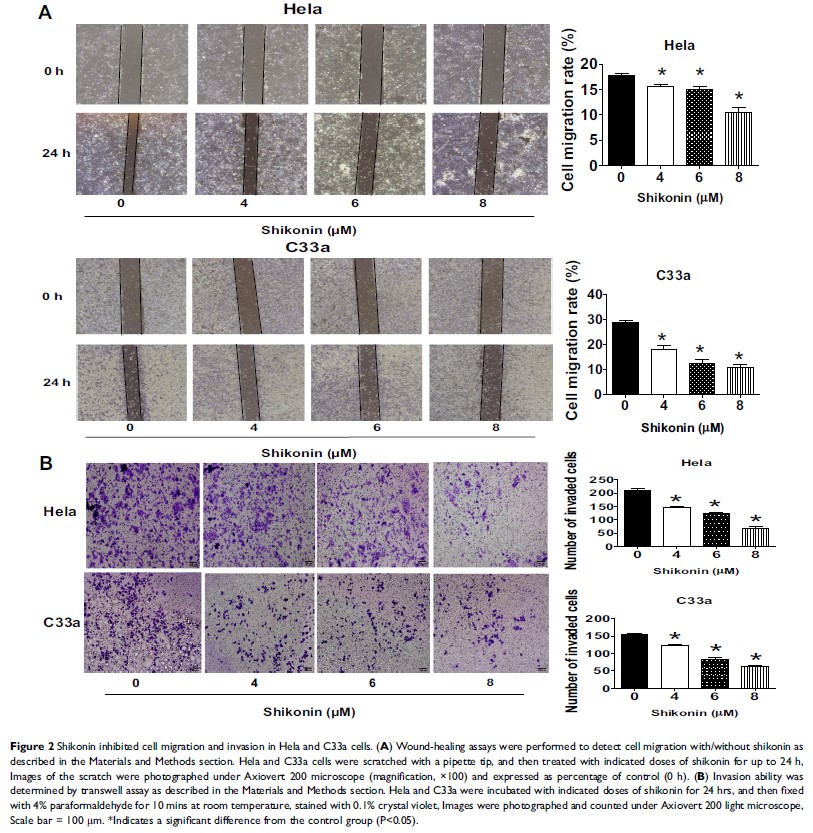
Results: We showed that shikonin inhibited cell viability, migration and invasion, and induced cell cycle arrest in a dose-dependent manner in cervical cancer Hela and C33a cells. Mechanistically, we found that shikonin increased miR-183-5p expression and inhibited expression of transcription factor Snail protein. The mimics of miR-183-5p reduced, while the inhibitors of miR-183-5p reversed shikonin-inhibited Snail protein expression. In addition, shikonin decreased Vimentin, increased E-cadherin protein expressions and E-cadherin promoter activity, the latter was reversed in cells transfected with exogenous Snail overexpression vectors. Moreover, silencing of E-cadherin significantly abolished shikonin-inhibited cervical cancer cell growth. Similar findings were also observed in vivo using one xenograft mouse model.
Conclusion: Our results show that shikonin inhibits EMT through inhibition of Snail and stimulation of miR-183-5p expressions, which resulted in induction of E-cadherin expression. Thus, blockade of EMT could be a novel mechanism underlying the anti-cervical cancer effects of shikonin.
Keywords: shikonin, EMT, cervical cancer, miR-183-5p, Snail, E-cadherin