114627
论文已发表
注册即可获取德孚的最新动态
IF 收录期刊
- 3.4 Breast Cancer (Dove Med Press)
- 3.2 Clin Epidemiol
- 2.6 Cancer Manag Res
- 2.9 Infect Drug Resist
- 3.7 Clin Interv Aging
- 5.1 Drug Des Dev Ther
- 3.1 Int J Chronic Obstr
- 6.6 Int J Nanomed
- 2.6 Int J Women's Health
- 2.9 Neuropsych Dis Treat
- 2.8 OncoTargets Ther
- 2.0 Patient Prefer Adher
- 2.2 Ther Clin Risk Manag
- 2.5 J Pain Res
- 3.0 Diabet Metab Synd Ob
- 3.2 Psychol Res Behav Ma
- 3.4 Nat Sci Sleep
- 1.8 Pharmgenomics Pers Med
- 2.0 Risk Manag Healthc Policy
- 4.1 J Inflamm Res
- 2.0 Int J Gen Med
- 3.4 J Hepatocell Carcinoma
- 3.0 J Asthma Allergy
- 2.2 Clin Cosmet Investig Dermatol
- 2.4 J Multidiscip Healthc

2014 年至 2018 年中国葫芦岛市人类布鲁氏菌病的流行病学、临床特征、治疗和预后分析
Authors Liu Z, Shen T, Wei D, Yu Y, Huang D, Guan P
Received 28 October 2019
Accepted for publication 21 January 2020
Published 11 February 2020 Volume 2020:13 Pages 435—445
DOI https://doi.org/10.2147/IDR.S236326
Checked for plagiarism Yes
Review by Single-blind
Peer reviewer comments 3
Editor who approved publication: Dr Eric Nulens
Purpose: To describe the incidence trend, demographic and clinical characteristics, treatment and prognosis, epidemiological history and risk factors of human brucellosis in Huludao, China.
Patients and Methods: A total of 1887 brucellosis patients were reported in Huludao, China from January, 2014 to December, 2018 and the case questionnaires from 1149 patients were collected from Huludao Municipal Center for Disease Control and Prevention. Demographic characteristics of the patients and the information relating to the patients’ clinical manifestations, diagnosis, treatment and prognosis were collected and analyzed.
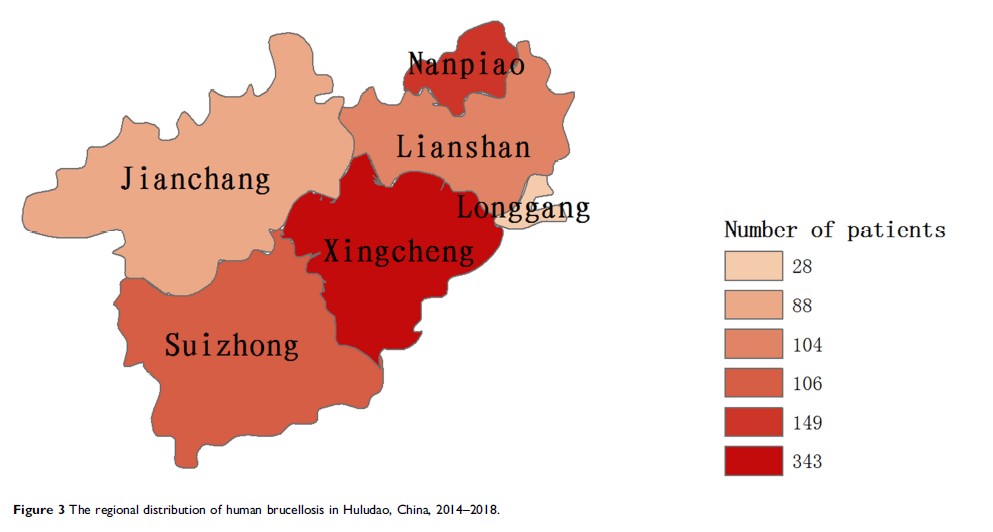
Results: The number of annually reported brucellosis patients has dropped from 711 to 187 during the study period, with the incidence decreased from 27.31/100,000 in 2014 to 7.15/100,000 in 2018. A total of 1149 individual data were collected, with a mean age of 49.59± 13.14 years and 75.7% were male. Patients aged more than 60 years were more likely to have arthralgia/myalgia than the other age groups, and patients who had an enlarged spleen in male were more than female (P < 0.05). There were more acute brucellosis cases, less sub-acute and chronic brucellosis cases in the ethnic minority (83.6%, 5.5% and 11.0%, respectively) than that in the Han nationality (64.7%, 22.2% and 13.0%, respectively, P < 0.05). For antibiotic therapy, “Doxycycline plus rifampicin or streptomycin” was the most commonly used drug combination. Sheep/goat was the main contacted animal and feeding/grazing was the most frequent transmission route; no personal protective measures were the major risk factor.
Conclusion: The incidence of human brucellosis is still high in Huludao, China, and this is mostly associated with contacting with domestic animals and barely taking protective measures. The most common clinical manifestations of brucellosis patients in Huludao were fatigue, hyperhidrosis, fever, and arthralgia/myalgia, the most common route of exposure was feeding and grazing, and the major species of livestock was sheep/goat. The most commonly adopted treatment option was antibiotic therapy, and most patients responded well to treatment. The integrality and accuracy of the notifiable epidemiological case questionnaire needs to be improved in order to provide more factual and objective information for both the physicians and policy-makers.
Keywords: human brucellosis, epidemiological characteristics, clinical features, treatment and prognosis