115195
论文已发表
注册即可获取德孚的最新动态
IF 收录期刊
- 3.6 Breast Cancer (Dove Med Press)
- 4.3 Clin Epidemiol
- 2.6 Cancer Manag Res
- 3.2 Infect Drug Resist
- 4.1 Clin Interv Aging
- 6.1 Drug Des Dev Ther
- 4.1 Int J Chronic Obstr
- 8.7 Int J Nanomed
- 2.5 Int J Women's Health
- 3.2 Neuropsych Dis Treat
- 2.4 OncoTargets Ther
- 2.6 Patient Prefer Adher
- 2.6 Ther Clin Risk Manag
- 3.1 J Pain Res
- 3.5 Diabet Metab Synd Ob
- 4.5 Psychol Res Behav Ma
- 3.4 Nat Sci Sleep
- 2.4 Pharmgenomics Pers Med
- 2.6 Risk Manag Healthc Policy
- 4.6 J Inflamm Res
- 2.3 Int J Gen Med
- 3.9 J Hepatocell Carcinoma
- 3.3 J Asthma Allergy
- 2.5 Clin Cosmet Investig Dermatol
- 3.0 J Multidiscip Healthc

AML 患者的 γ-连环蛋白过表达可能通过激活 Wnt/β-连环蛋白轴来提高肿瘤细胞存活率
Authors Qian J, Huang X, Zhang Y, Ye X, Qian W
Received 13 September 2019
Accepted for publication 3 February 2020
Published 12 February 2020 Volume 2020:13 Pages 1265—1276
DOI https://doi.org/10.2147/OTT.S230873
Checked for plagiarism Yes
Review by Single-blind
Peer reviewer comments 4
Editor who approved publication: Prof. Dr. Jianmin Xu
Background: Canonical Wnt/β-catenin signaling is frequently dysregulated in acute myeloid leukemia (AML) and has been implicated in leukemogenesis. γ-catenin was previously demonstrated to be associated with the nuclear localization of β-catenin, the central mediator, and to exert oncogenic effects in AML; however, the underlying mechanisms remain unclear. Our study aimed to investigate the expression characteristics of γ-catenin in AML patients, explore the mechanisms by which γ-catenin regulates β-catenin, and discuss the feasibility of targeting γ-catenin for AML treatment.
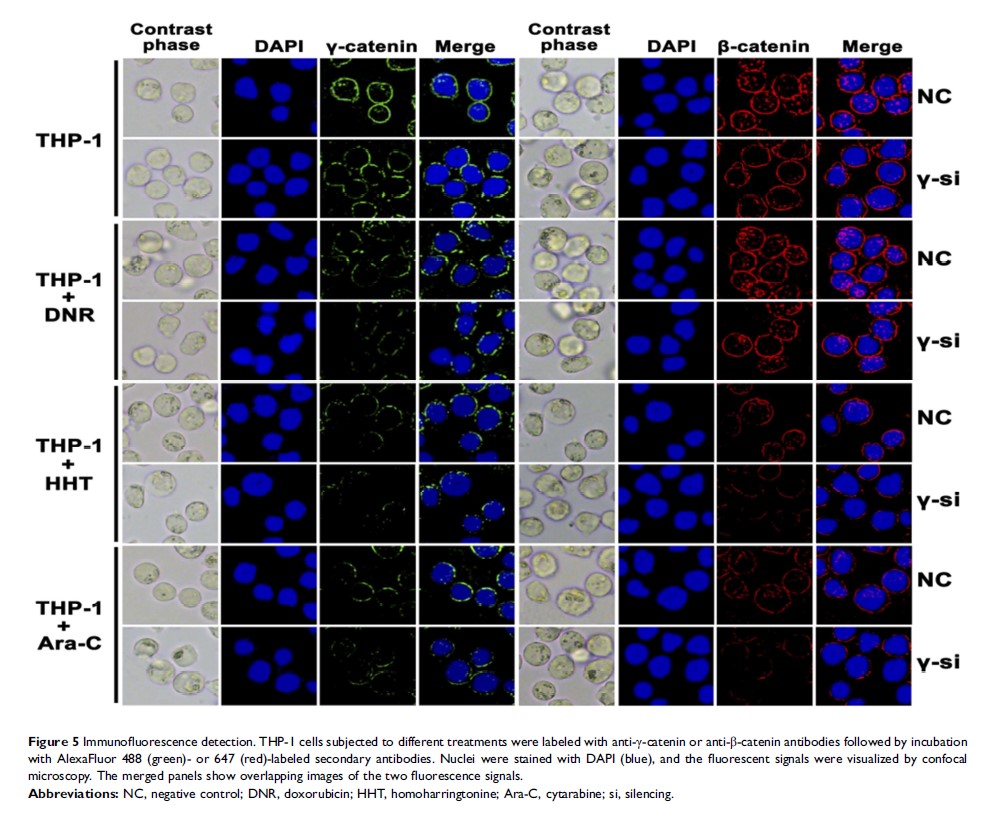
Methods: The mRNA expression levels of γ-catenin in AML patients were measured by qRT-PCR. Cell proliferation was examined via Cell Counting Kit-8 (CCK-8) assays. The expression levels of related proteins were measured via Western blotting. Specific siRNA was used to modulate the expression level of the γ-catenin gene. Apoptosis and cell cycle distribution were quantified by flow cytometry. The subcellular localization of γ-catenin and β-catenin was examined via immunofluorescence with a confocal laser scanning microscope.
Results: Overexpression of γ-catenin was frequently observed in AML and correlated with poor prognosis. Consistent with this finding, suppression of γ-catenin in the AML cell line THP-1 induced growth inhibition, promoted apoptosis and blocked β-catenin nuclear translocation. Interestingly, γ-catenin knockdown sensitized THP-1 cells to cytotoxic chemotherapeutic agents such as cytarabine and homoharringtonine and further inhibited β-catenin nuclear localization. Moreover, our data implied the relationship between γ-catenin and GSK3β (whose effect on β-catenin is mediated by its own phosphorylation), which may be the principal mechanism underlying the anti-AML effect of γ-catenin inhibition.
Conclusion: Taken together, our results revealed a potential role of γ-catenin in AML pathogenesis–mainly through the inhibition of GSK3β-mediated nuclear localization of β-catenin–and indicate that targeting γ-catenin might offer new AML treatments.
Keywords: acute myeloid leukemia, γ-catenin, β-catenin, chemotherapy